

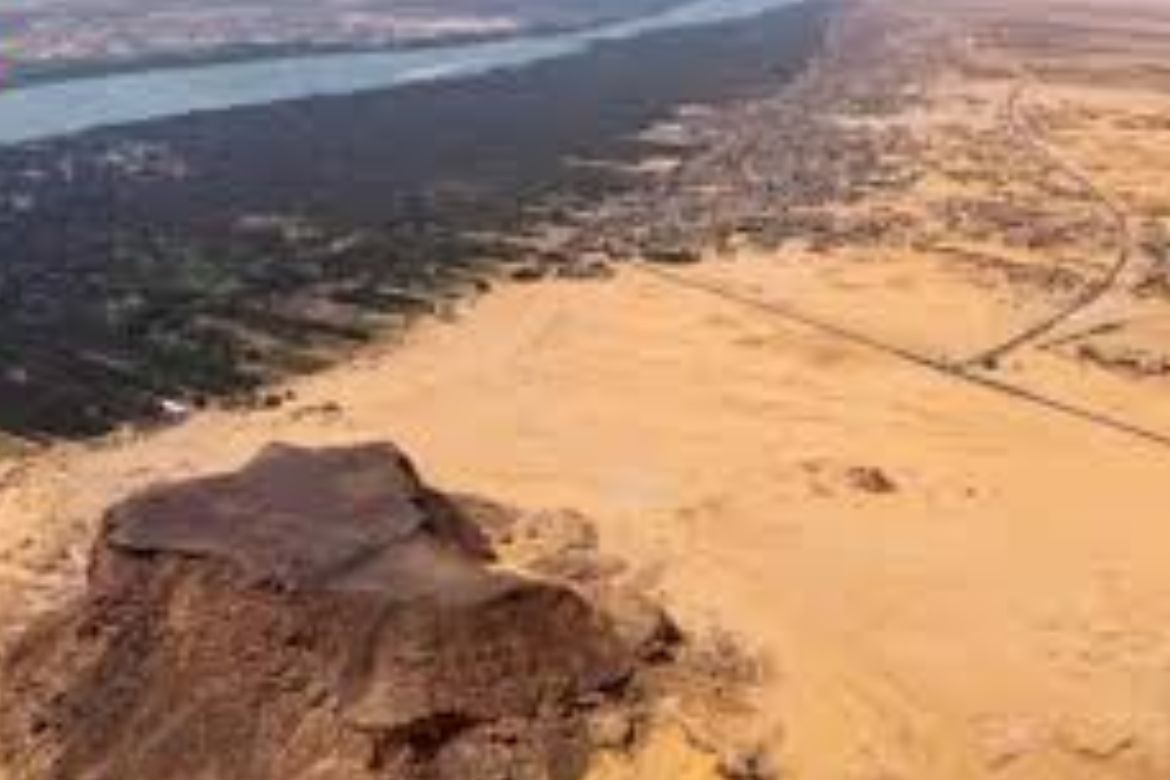
History often celebrates kings, wars, and monuments—but sometimes, the real force behind an empire is far quieter. In the case of Napata, an ancient city in what is now Sudan, the turning point wasn’t a ruler or a conquest—it was a river slowing down.
Recent research has revealed that the Nile River’s changing flow around 4,000 years ago played a decisive role in shaping the landscape that allowed Napata—and the wider Kingdom of Kush—to rise and thrive for centuries.
When the Nile Changed Its Rhythm
For thousands of years, the Nile was a restless force, carving deeply into the land as it flowed northwards. But around 2000 BCE, something remarkable happened: the river’s valley levelled out, and its energy began to ease.
Instead of aggressively eroding land, the Nile started slowing down and depositing sediment—fine layers of clay and silt that gradually built up the valley floor. Over time, these deposits grew to form a fertile floodplain, in some places up to 10 metres thick.
This shift was not just geological—it was transformational. It turned a difficult landscape into one capable of sustaining life, agriculture, and eventually, cities.
The Rise of Napata
It was in this newly stabilized environment that Napata emerged.
Located near Jebel Barkal, a sandstone outcrop that would later become a UNESCO World Heritage Site, Napata evolved into a major urban, cultural, and political centre of the Kingdom of Kush. The city flourished from about 800 BCE to 100 CE, but its success was deeply rooted in the environmental changes that had begun millennia earlier.
The slow-moving Nile created ideal conditions:
- Fertile soil from accumulated sediments supported agriculture
- Reduced flood risk made long-term settlement possible
- Reliable water access sustained population growth
These advantages allowed Napata not just to survive, but to endure and expand as a regional powerhouse.
Nature’s Hidden Advantage: The Fourth Cataract
Another natural feature helped shape Napata’s destiny—the Fourth Cataract of the Nile.
Cataracts are stretches of rocky rapids and islands that break up the river’s flow. Located just upstream of Napata, the Fourth Cataract acted like a natural brake, slowing the river even further and encouraging sediment to settle.
This created a unique local balance:
- Enough water flow to sustain life
- Enough resistance to prevent destructive flooding
- Ideal conditions for sediment accumulation
In much of Sudan, these geological features can disrupt travel and fragment settlements. But in Napata’s case, they created a sweet spot—a landscape where civilization could flourish.
The Kingdom of Kush: A Forgotten Power
Napata wasn’t just another settlement—it was the beating heart of the Kingdom of Kush, one of the ancient world’s most influential but often overlooked empires.
After the decline of ancient Egypt around 1200 BCE, Kush rose to prominence, interacting with major powers including:
- Egypt
- Assyria
- Greece and Persia
- The Roman Empire
From Napata, Kushite rulers built pyramids, temples, and palaces, particularly around Jebel Barkal, showcasing a rich blend of African and Egyptian cultural influences.
Even the Greek historian Herodotus wrote about Kush, highlighting its significance in the ancient world.
Science Unlocks an Ancient Secret
To understand why Napata succeeded where others struggled, researchers carried out an extensive investigation into the region’s geology.
Their work included:
- Analysing 12,500 years of Nile history
- Drilling 26 boreholes across the valley
- Using optically stimulated luminescence dating to track sediment ages
Their conclusion was clear:
Where the Nile slowed and sediments accumulated, civilizations could thrive.
This insight is especially important because, historically, the Nile in Sudan has been less studied than in Egypt. Yet, as this research shows, it holds crucial clues to understanding the broader story of ancient African civilizations.
A Lesson in Balance
What makes the Nile so unique is not just its size or reach, but its rhythm.
In Egypt and Nubia alike, the river’s predictable, measured flow allowed societies to:
- Plan agriculture with confidence
- Build stable communities
- Develop complex political and cultural systems
Unlike fast and unpredictable rivers that brought destruction, the Nile offered something far more valuable: consistency.
The story of Napata is a powerful reminder that history is not shaped by human ambition alone. Sometimes, it is shaped by the quiet work of nature over thousands of years.
When the Nile slowed 4,000 years ago, it did more than change a river—it created the conditions for an empire.
And in that slow, steady flow lies a timeless lesson:
True power does not always come from force—it often comes from balance.
