

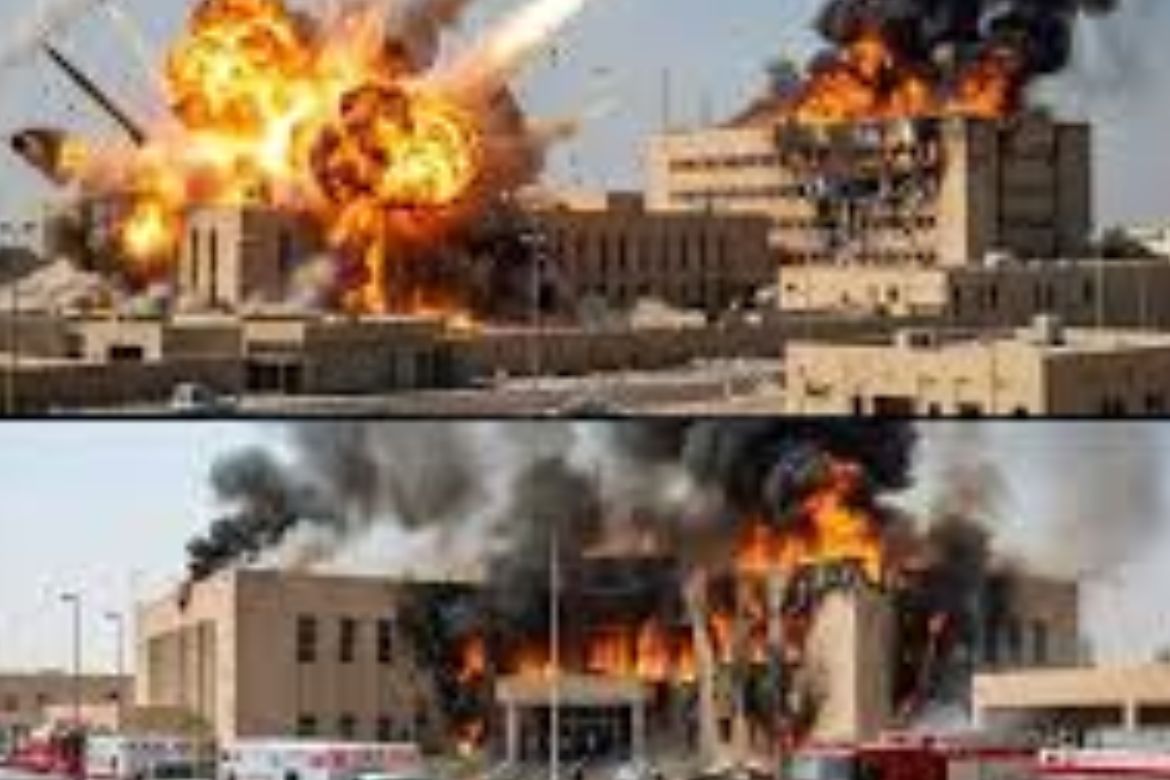
The Middle East conflict entered a volatile new phase on June 3–4, 2026, as Kuwait released CCTV footage of a deadly strike on its international airport—an incident that has intensified the ongoing Iran war and exposed cracks in fragile ceasefire efforts elsewhere in the region.
While diplomatic talks in Washington produced a tentative ceasefire agreement between Israel and Lebanon, renewed strikes, political divisions, and conflicting claims over the Kuwait attack highlight a stark reality: the region remains on edge, with escalation and diplomacy unfolding simultaneously.
Kuwait Airport Strike: Footage at the Centre of a Global Dispute
Kuwait’s Civil Aviation Authority released surveillance footage showing what it said was an Iranian drone strike on Terminal 1 of Kuwait International Airport.
The video appears to show a projectile striking the terminal roof, followed by a large explosion that caused structural damage and panic among passengers and staff.
According to Kuwaiti authorities:
- The attack killed one person and injured more than 60
- Airport operations were temporarily suspended
- The strike targeted civilian infrastructure, raising alarm over aviation safety
Kuwait has described the incident as “brutal Iranian aggression”, presenting the footage as evidence of a direct attack.
However, Iran has strongly denied responsibility, claiming the damage was caused by a malfunctioning US-made Patriot interceptor missile rather than an Iranian drone or missile.
This conflicting narrative has intensified tensions between Iran, the United States, and Gulf countries.
Ceasefire Between Israel and Lebanon Shows Signs of Strain
Just hours before the CCTV footage emerged, Israel and Lebanon announced an agreement to implement a US-brokered ceasefire following talks in Washington.
The agreement was seen as a potential step toward de-escalation in a conflict that has spread since the Iran war began in February. However, developments on the ground quickly contradicted that optimism:
Israeli strikes were reported overnight in southern Lebanon
Multiple targets, including vehicles, were hit, causing injuries
Israel warned civilians to avoid certain areas, citing ongoing operations
Israeli officials also signalled continued military intent. Defence Minister Israel Katz stated that operations would continue and that Israel retained the ability to strike Beirut if necessary.
Meanwhile, Israeli minister Itamar Ben-Gvir criticised the ceasefire, calling it a “serious mistake” and warning that it effectively legitimises Hezbollah.
These developments underscore the fragile nature of ceasefire agreements in the region, where political commitments often fail to translate into immediate calm on the ground.
United States: Political Pressure and Mixed Messaging
In Washington, the Iran war is increasingly shaping domestic political debate.
The US House of Representatives voted 215–208 in favour of a resolution aimed at curbing military engagement in Iran without congressional approval. While largely symbolic, the vote reflects growing concern within US political circles over the direction of the conflict.
At the same time, US President Donald Trump delivered mixed signals on both the Kuwait attack and broader diplomacy:
- He said Iran may have been “slightly provoked” by recent US military actions before striking Kuwait
- He suggested a potential Iran deal could be reached “over the weekend”, but acknowledged uncertainty
These comments highlight the dual-track US strategy: applying military pressure while keeping diplomatic channels open.
Rising Violence Beyond Borders
The Kuwait airport strike is part of a wider escalation across the Middle East:
- Iran-linked attacks have targeted Kuwait and Bahrain, including missiles and drones
- Bahrain reported intercepting multiple projectiles aimed at infrastructure
- Oman condemned the attacks and called for restraint and dialogue
In Lebanon, the violence has also affected international forces:
- A UN peacekeeper was killed after shells struck a UNIFIL position
- Two others were wounded
- UNIFIL reported increasing projectile activity and urged de-escalation
These incidents show that the conflict is no longer limited to direct combatants, with regional stability and international security now at stake.
Iran’s Position: Unity Amid Pressure
Iranian leadership has responded by emphasising resilience and internal unity.
Supreme Leader Mojtaba Khamenei warned that Iran’s adversaries, having failed on the battlefield, are now attempting to weaken the country through psychological and political pressure. He urged citizens and officials to maintain cohesion and avoid actions that could create division.
Iran has also maintained that any broader settlement to end the conflict must include developments in Lebanon, signalling its continued strategic involvement across multiple fronts.
Analysis: A Region at a Turning Point
The latest developments point to a critical juncture in the Iran war:
- Civilian Infrastructure Under Threat
The Kuwait airport attack demonstrates how civilian targets are increasingly caught in the crossfire, raising concerns about safety across the Gulf. - Fragile Diplomacy
Ceasefire agreements, such as the one between Israel and Lebanon, remain conditional and unstable, with violations occurring within hours. - Escalation and Negotiation Coexist
The US and Iran are simultaneously engaging in military exchanges and diplomatic talks, creating an unpredictable security environment.
Conclusion
The release of CCTV footage from Kuwait has not only provided a stark visual account of destruction but also intensified the geopolitical struggle over narratives and responsibility.
At the same time, ceasefire efforts, political divisions, and continued military strikes reveal a deeper truth about the current state of the conflict:
The Middle East is caught between the momentum of war and the urgency of diplomacy—and neither side has yet gained the upper hand.
With speculation over a possible US–Iran deal and continued tensions across Lebanon and the Gulf, the coming days will be critical in determining whether the region moves toward stability or deeper conflict.
