

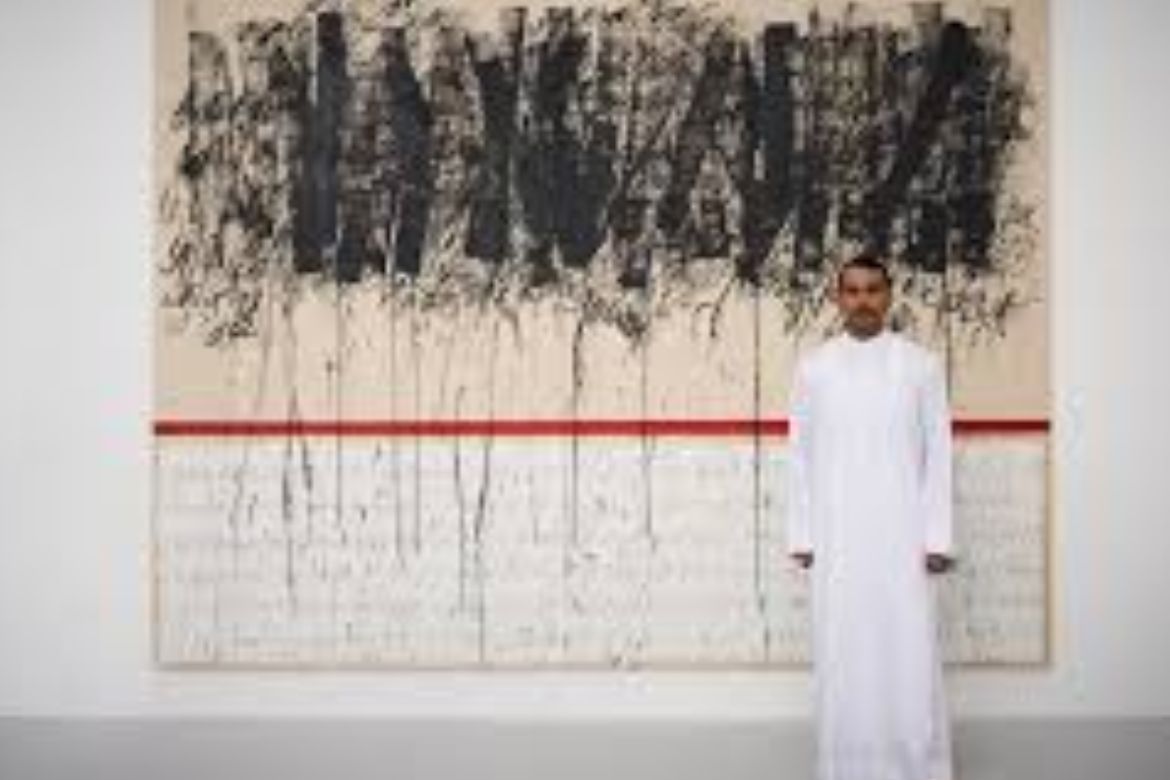
In Juma Al Haj’s latest exhibition at Iris Projects, one painting commands immediate attention. A bold red line cuts across the canvas, dividing it into two worlds.
Below it, familiar territory: abstract, calligraphic strokes—methodical, controlled, and flowing as steady rivulets of white. This is the Juma Al Haj viewers recognise.
Above it, everything changes.
Black bars clash across a storm of wiry scrawls. Paint drips freely, breaking form and discipline. The chaos refuses containment, spilling over the red line and intruding into the calm below. It feels unsettling—deliberately so.
This rupture is not just aesthetic. It is emotional, psychological, and deeply tied to a moment that shook the UAE’s sense of security: the Iranian-linked missile attacks of 2022.
A Moment That Crossed More Than Borders
The painting, Black Cloud, Red Line, was created in the months following those attacks—events that disrupted not just physical space, but perception itself.
The UAE has long been associated with safety and stability. But as Al Haj reflects, that sense of safety is as much emotional as it is physical. When it is threatened, the impact goes beyond immediate danger.
It unsettles the mind.
In this context, the red line becomes more than a visual divider. It is a metaphor for a boundary—between safety and uncertainty, control and vulnerability. When crossed, it leaves behind a lingering tension, one that quietly permeates everyday life.
From Order to Uncertainty
Al Haj’s earlier works are defined by precision. His abstract calligraphy—rooted in personal explorations of Arabic letterforms—has always been contained, thoughtful, and deliberate.
But in Interoception, his latest exhibition, that control begins to loosen.
The artist experiments with unpredictability. Diluted paint is allowed to drip freely. Water guns are used to splatter colour across the canvas. Styrofoam slabs create rough, textured surfaces. These techniques introduce a sense of chaos into his otherwise structured practice.
And yet, this is not abandonment.
Behind the apparent disorder lies careful thought. Al Haj continues to journal, conceptualise, and reflect before each piece. The tension between planning and spontaneity becomes central to the work—mirroring the tension between stability and disruption in lived experience.
Painting Anxiety Without Naming It
One of the most striking motifs in the exhibition is the use of bold yellow forms. These shapes are inspired by the emergency alerts that appeared on residents’ phones during the attacks—urgent warnings that interrupted daily life.
Translated onto canvas, the yellow becomes impossible to ignore.
In some works, it overlays the calm white strokes, disrupting their rhythm. In others, it takes over entirely, swallowing the composition whole. It carries a sense of urgency, echoing the psychological weight of those moments when uncertainty felt immediate and unavoidable.
These paintings do not depict explosions or conflict directly. Instead, they capture the emotional residue—anxiety, alertness, and the quiet unease that follows disruption.
A Night That Became a Painting
Among the works in Interoception is one born from a moment of raw experience.
During the first week of Ramadan, just before suhoor, Al Haj heard a blast. The windows shook. Outside, there was only darkness.
He responded instinctively—going straight to his studio.
The painting that emerged is stark and immediate: ghostly white forms against a deep black background, edged with faint golden tones. It reflects not just what he saw, but what he felt in that moment—confusion, fear, and urgency.
Unlike his other works, it was completed in hours, bypassing his usual process of careful planning. It stands as a direct imprint of experience before it could be fully understood.
The Balance Between Inner and Outer Worlds
While the attacks serve as a catalyst, Al Haj’s work resists being confined to a purely political reading.
Interoception, as its title suggests, is about internal awareness—how external events are absorbed and processed within us. The paintings explore not just geopolitical tension, but personal anxiety, memory, and identity.
This layered approach allows the works to exist in multiple dimensions. They are at once:
- Reflections of a nation confronting unexpected vulnerability
- Explorations of individual emotional landscapes
- Meditations on the fragile balance between order and chaos
A Language Born from Personal History
Al Haj’s distinctive visual language has always been deeply personal. Growing up in the United States, he often felt disconnected from his cultural roots. Exercises in Arabic handwriting evolved into fluid, abstract gestures—forms that eventually became central to his artistic identity.
These gestures have long served as a means of expression when words fell short.
Now, in Interoception, that same language is being pushed to its limits. The ordered strokes that once symbolised control are disrupted, challenged, and reshaped by external pressure.
Finding Meaning in Disorder
What makes this body of work so compelling is its embrace of uncertainty.
Rather than resisting disorder, Al Haj allows it to enter his practice. He crosses his own artistic “red line,” stepping into unpredictability and imperfection. In doing so, he captures something deeply human—the way we try to make sense of events that defy understanding.
His paintings remind us that disruption does not simply destroy order; it transforms it.
Beyond the Canvas
Interoception marks a significant moment in Al Haj’s artistic journey. As he transitions into a full-time art career and prepares to study at the Paris College of Art, his work is entering a new phase—one defined by risk, experimentation, and emotional depth.
But beyond career milestones, this exhibition offers something more lasting.
It reveals how art can hold the aftershocks of lived experience—how it can translate fear, uncertainty, and resilience into form.
And in that sense, the red line is not just something that was crossed.
It is something that continues to reshape what lies on either side of it.
