

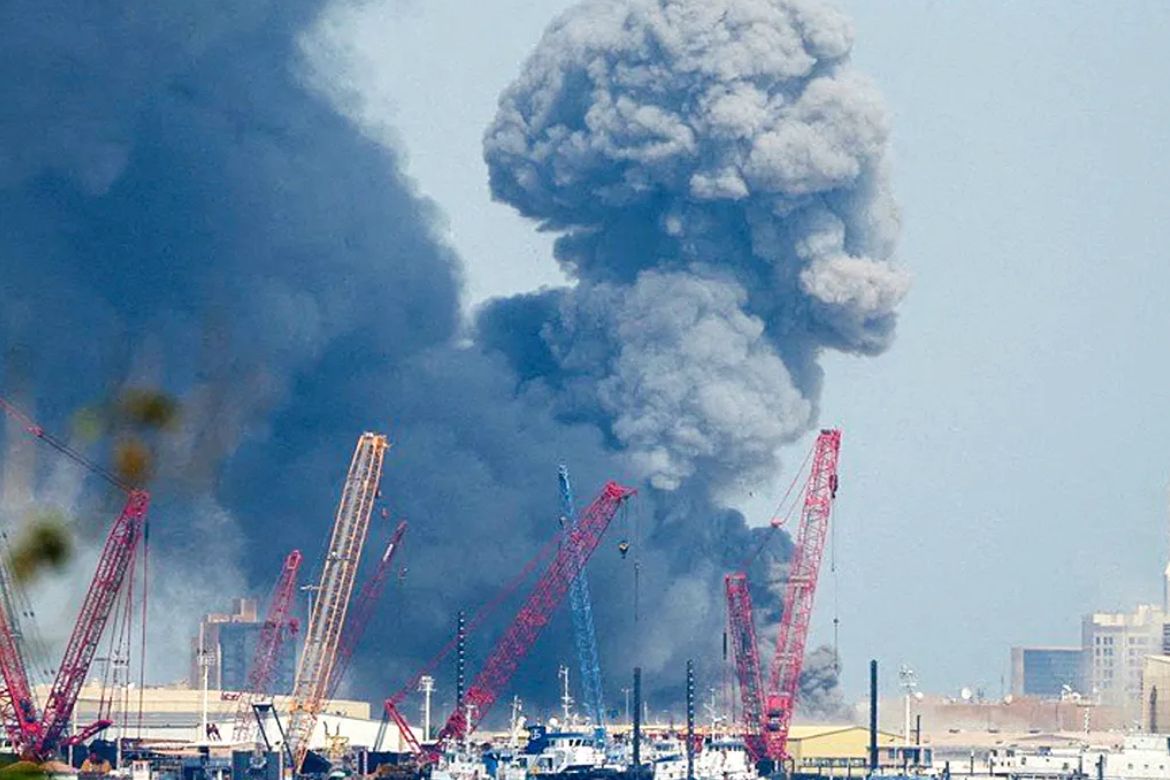
The Gulf region has been placed on heightened alert after Iran launched a fresh wave of missile and drone attacks targeting US-linked military facilities in Bahrain, Jordan, Kuwait and Oman, marking a significant escalation in the ongoing confrontation between Tehran and Washington.
The attacks came shortly after US Central Command (Centcom) confirmed a new round of military strikes against Iranian targets, including air defence systems, missile capabilities, drone infrastructure and coastal radar installations. Washington said the operation was intended to degrade Iran’s ability to disrupt global shipping and threaten vessels transiting the Strait of Hormuz.
In response, Iran’s Islamic Revolutionary Guard Corps (IRGC) claimed responsibility for coordinated missile and drone strikes against military installations across the Gulf and Jordan, asserting that the attacks were retaliation for American military operations.
Regional Security Concerns Intensify
According to Iranian claims, targets included Sheikh Isa Air Base in Bahrain, Prince Hassan Air Base in Jordan, Ali Al Salem Air Base in Kuwait and strategic radar facilities in Oman. Tehran alleged that military infrastructure, fuel depots and air defence systems were damaged, although the claims have not been independently verified.
Authorities across the region immediately activated emergency protocols.
Bahrain confirmed that air raid sirens were sounded multiple times, urging citizens and residents to seek safety and follow official guidance.
Jordan’s military reported intercepting four missiles that entered its airspace from Iranian territory, while Kuwait’s armed forces announced that air defence systems were engaging hostile aerial targets within national airspace.
The incidents underscore the growing risks facing Gulf nations as the US-Iran conflict increasingly spills beyond bilateral military exchanges.
Gulf Leaders Rally Behind Regional Security
The strongest reactions came from Gulf governments, which united in condemning the attacks and reaffirming support for regional stability.
Saudi Arabia, through its Ministry of Foreign Affairs, denounced what it described as Iran’s continued destabilising actions and condemned attacks targeting Gulf countries, commercial shipping and freedom of navigation. Riyadh reaffirmed its rejection of any violation of the sovereignty of neighbouring states and warned against actions threatening regional security.
Qatar condemned the missile and drone attacks in the strongest terms, describing them as a “dangerous escalation” that risks undermining diplomatic efforts and regional peace. Qatari officials also reiterated support for dialogue as the only sustainable path towards de-escalation.
Oman, traditionally a key regional mediator, lodged a formal protest following reports that radar installations on its territory were targeted. Muscat condemned the attack as a violation of its sovereignty and called for an immediate halt to actions that could further destabilise the region.
Kuwait’s Foreign Ministry issued a strong condemnation, describing the attacks as a serious breach of sovereignty and a direct threat to national security, regional stability and the safety of citizens and residents.
In a broader show of unity, Gulf countries and Jordan reaffirmed their commitment to defending national sovereignty and preserving regional stability, stressing that attacks against any state in the region represent a threat to collective security.
Europe Backs Gulf Allies
International support for Gulf states quickly followed.
France, Germany and the United Kingdom jointly condemned Iran’s attacks on Gulf countries and reiterated their support for Bahrain, Qatar, Kuwait, Oman and Jordan. The European powers also called for the restoration of freedom of navigation in the Strait of Hormuz and urged all parties to return to diplomatic negotiations.
The Arab Parliament similarly condemned the missile and drone attacks, warning that continued escalation could further destabilise the region and calling for urgent international action to uphold security and international law.
Hormuz Remains at the Centre of the Crisis
The military escalation comes as tensions surrounding the Strait of Hormuz continue to unsettle global markets.
Iran has maintained that maritime traffic through the strategic waterway remains disrupted, while the US insists the corridor remains open and protected. Shipping data suggests vessel movements have fallen sharply in recent days, prompting fresh concerns about global energy supplies and trade flows.
Oil markets reacted swiftly, with Brent crude climbing as investors assessed the risk of prolonged disruption along one of the world’s most important energy routes.
The latest attacks mark a critical turning point in the evolving US-Iran confrontation.
What was once a direct dispute between Washington and Tehran has now drawn multiple Gulf countries into the security equation. The strong and coordinated response from Gulf leaders reflects growing concern that regional stability, economic confidence and freedom of navigation are all under increasing pressure.
For Gulf nations, the priority remains clear: protecting sovereignty, maintaining regional security and preventing a broader conflict that could have lasting consequences for the Middle East and the global economy.
As military operations continue and diplomatic channels remain under strain, the coming days could prove decisive for the future of regional stability.
