

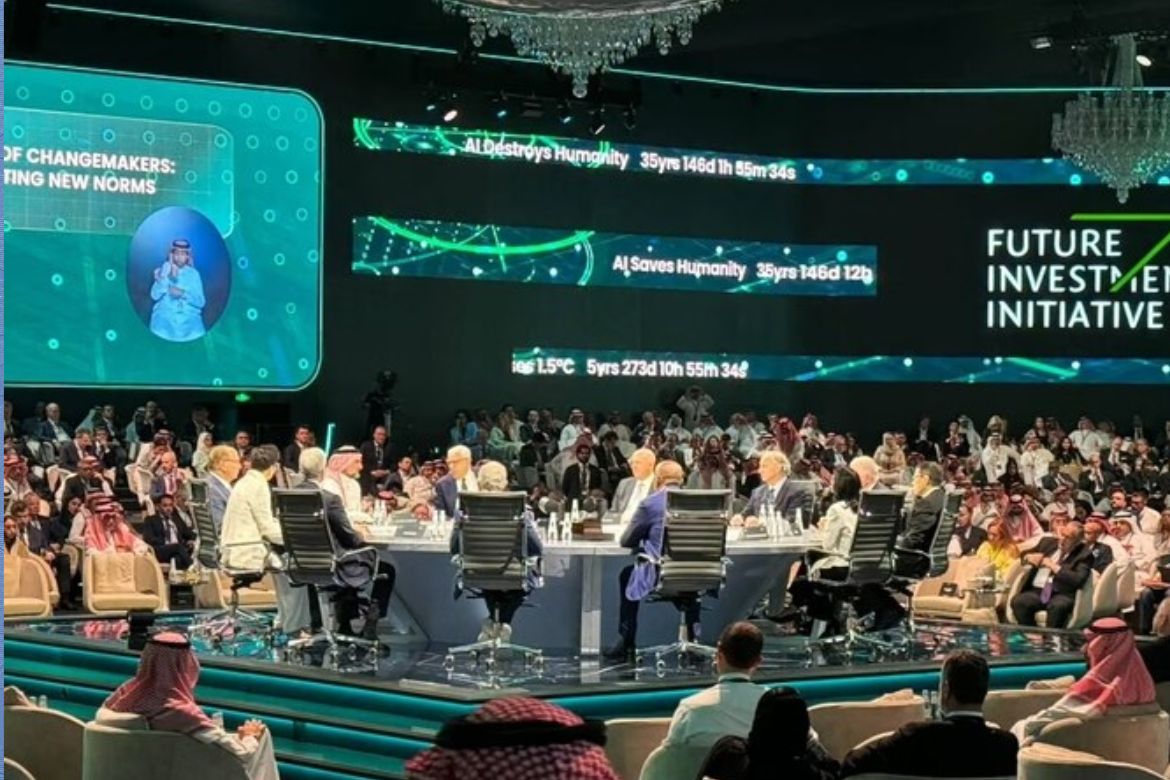
Riyadh is once again at the center of global finance.
Next week, the Saudi capital will welcome an elite lineup of world leaders, financiers, innovators, and policymakers for the ninth edition of the Future Investment Initiative (FII) — the Kingdom’s annual power summit often dubbed “Davos in the Desert.”
Under the theme “The Key to Prosperity: Unlocking New Frontiers of Growth,” this year’s FII arrives at a delicate juncture. The optimism of a soft economic rebound is shadowed by growing geopolitical risks, frothy capital markets, and an alarming surge in global debt that’s testing investor confidence worldwide.
For Saudi Arabia — and for the wider Gulf — the stakes are high.
A Convergence of Global Power
Over the three-day summit starting October 27, 20 heads of state and more than 600 global speakers will converge at the King Abdulaziz International Conference Center. On the agenda: the future of finance, artificial intelligence, energy, and sustainable growth.
The event’s opening will see Yasir Al Rumayyan, Governor of Saudi Arabia’s nearly $1 trillion Public Investment Fund (PIF), deliver the keynote address. His remarks are expected to set the tone for the Kingdom’s next phase of Vision 2030 — a transformation built on diversification, mega-projects, and technology-driven growth.
The lineup of global visionaries is striking. Nobel Peace Prize laureate Muhammad Yunus and World Trade Organisation Director-General Ngozi Okonjo-Iweala will both deliver special addresses.
Heavyweights from the world of finance — including Citigroup’s Jane Fraser, Goldman Sachs’ David Solomon, Standard Chartered’s Bill Winters, JPMorgan’s Jamie Dimon, HSBC’s Georges Elhedery, and Barclays’ C.S. Venkatakrishnan — are set to share the stage with Saudi Investment Minister Khalid Al Falih in discussions around “geonomics,” global markets, and public–private collaboration.
The regional financial voice will also be strong: Tareq Al Sadhan (Saudi National Bank), Karim Awad (EFG Hermes), and Tony Cripps (Saudi Awwal Bank) are among the leading Arab bankers expected to weigh in on how Gulf institutions can shape tomorrow’s investment landscape.
Wall Street, the Gulf, and the Search for Stability
Global investment and wealth management giants will be well represented — KKR, Brookfield, Investcorp, Bridgewater, Carlyle, Ark Invest, and others. Together, they manage trillions of dollars in assets and will use the FII stage to assess whether growth can be sustained amid slowing trade, rising rates, and unsettling debt levels.
The so-called “AI boom” will feature prominently too. While investors are chasing record valuations, many at FII are expected to debate whether the momentum represents innovation or an impending bubble.
As one regional analyst told The Gulf Talk, “The paradox of this moment is clear — innovation is driving optimism, but leverage and liquidity are driving fear.”
Economic Context: ‘Steady but Fragile’
The International Monetary Fund recently upgraded its 2025 growth outlook, predicting global output of 3.2 percent, citing resilience in private markets despite tariff headwinds. But its warning was blunt: the outlook remains “steady but fragile.”
IMF Chief Economist Pierre-Olivier Gourinchas summed it up best — “Not as bad as we feared, but worse than we need.”
That line could very well define the mood in Riyadh this week. While the global economy hasn’t derailed under shifting trade policies and political uncertainty, the sense of unease persists. With debt at record highs and rate cuts still elusive, the sustainability of global expansion will dominate conversations.
Energy, Transition, and the Gulf Factor
Energy transition — a perennial Gulf concern — will also take center stage.
Saudi Energy Minister Prince Abdulaziz bin Salman, Aramco CEO Amin Nasser, Engie CEO Catherine MacGregor, and TotalEnergies Chairman Patrick Pouyanné are set to lead the debate on reconciling global decarbonisation goals with energy security.
As The Gulf Talk notes, the conversation is shifting from “how fast to move” to “how to move together.” For Gulf economies, the challenge lies in balancing oil revenues with the pivot to renewables and new technologies — a balancing act that defines the region’s Vision 2030 era.
UAE Presence: Regional Collaboration in Action
The UAE’s corporate elite will also make their presence felt. Among the confirmed speakers are:
- Mohamed Alabbar, Founder, Emaar Properties
- Jasim Husain Thabet, Managing Director, Taqa Group
- Mohamed Jameel Al Ramahi, CEO, Masdar
- Dino Varkey, CEO, GEMS Education
- Ahmed Ismail, CEO, Majid Al Futtaim Holding
Their inclusion reflects the deepening Saudi–UAE alignment in economic strategy, with both countries investing heavily in infrastructure, technology, and sustainability as part of their shared regional future.
The Gulf Talk Take: Between Optimism and Overextension
The 2025 FII Summit isn’t just another investment conference — it’s a stress test for the new global order.
Saudi Arabia’s ambition is unmistakable: to cement its role as the region’s investment nerve center, to lead in energy and AI innovation, and to prove that its diversification drive can outpace volatility.
But ambition meets anxiety. The global debt overhang, fragile capital markets, and the AI-driven valuation surge raise the question — can global finance sustain another super-cycle without tipping into instability?
For the Gulf, the message is clear: while opportunity abounds in digital transformation, green energy, and infrastructure, prudence must guide ambition. As the world gathers in Riyadh, investors and policymakers alike are reminded that the path to prosperity is not just about unlocking growth — but managing risk.
When the curtains rise on FII 2025, the discussions in Riyadh will go far beyond investment headlines. They will reveal how the Gulf’s economic giants — led by Saudi Arabia — intend to navigate a world where optimism is fragile, but opportunity remains vast.
