

Washington’s policy towards Iran has entered a phase defined less by crisis management and more by sustained control. Rather than seeking a decisive breakthrough or a rapid diplomatic settlement, the United States is pursuing a strategy built on maximising pressure while avoiding open military confrontation. The aim is not resolution, but regulation — keeping tensions within calculated limits that preserve deterrence without triggering a wider regional war.
For the US administration, this approach reflects a sober assessment of the costs of direct conflict and the risks of destabilising an already fragile Middle East. Stability, in this context, is no longer a by-product of power projection, but a strategic objective in its own right. Managing escalation has become as important as demonstrating strength.
President Donald Trump’s handling of Iran fits squarely within this framework. Economic sanctions, diplomatic isolation and military signalling are used in tandem to alter Tehran’s behaviour without committing to full-scale military engagement. War is neither the preferred outcome nor the assumed endpoint. Instead, tension itself is treated as a policy tool — a means of exerting influence, applying pressure and recalibrating deterrence.
US-Iran relations are therefore managed as an open-ended dossier, subject to tightening or relaxation depending on political calculations in Washington. Pressure is designed to raise the cost of Iran’s regional posture, compelling reassessment rather than collapse. Regime change is not the stated objective; narrowing Iran’s strategic options and limiting its regional reach is.
Central to this strategy is the maintenance of a credible threat of escalation without its immediate execution. Military force remains on the table, not as rhetoric, but as a calculated component of deterrence. By preserving the ability to escalate — while carefully controlling timing and scope — Washington seeks leverage without paying the price of war. This logic explains the coexistence of forceful language, economic pressure and deliberate military restraint.
At the same time, the possibility of limited escalation remains real. US policymakers continue to consider options that could disrupt or temporarily degrade Iranian capabilities without crossing into full-scale conflict. These include precise military strikes, cyber operations and high-impact technological measures, executed below the escalation threshold and paired with continued economic pressure. Internal pressures within Iran, including public unrest, are viewed as part of a longer-term attrition strategy rather than a substitute for military decision-making.
Iran, meanwhile, has responded with a strategy of patience rather than provocation. Instead of mirroring escalation, Tehran has focused on absorbing pressure through economic adaptation, strengthening deterrent capabilities and expanding its regional manoeuvring space. While sanctions have inflicted significant economic damage, they have not forced a fundamental shift in Iranian policy. Instead, they have reinforced Tehran’s belief that managing tension is less costly than attempting to resolve it on Washington’s terms.
Despite mounting pressure, Iran has preserved the cohesion of its political system, albeit at a considerable economic cost. Financial strain, technological limitations and declining capacity have become more visible, but they have not translated into strategic capitulation. The confrontation has thus evolved into a long-term standoff defined by sanctions, isolation and indirect pressure rather than decisive military action.
The military dimension remains present within a framework of mutual deterrence. The United States signals readiness to act when necessary, while Iran maintains its deterrent posture without pushing towards direct confrontation. Between the two lies a persistent grey zone — neither war nor settlement — managed through signalling, proxy activity and the constant testing of red lines.
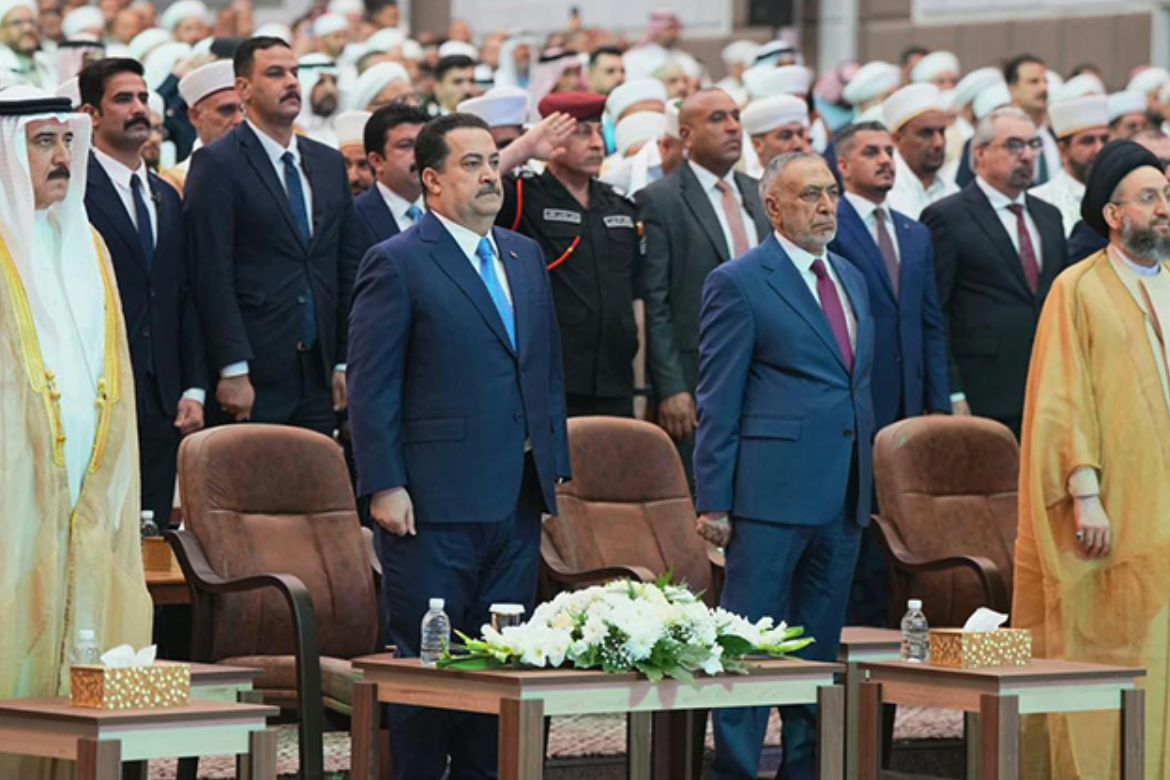
It is within this grey zone that Iraq finds itself most exposed. Baghdad is neither treated as a neutral actor nor openly designated a battlefield. Instead, it has become a buffer space — expected to absorb the spillover of US-Iranian tensions while preventing them from escalating into direct conflict. Iraqi leaders operate within a narrow margin, avoiding overt alignment, maintaining channels with both sides and prioritising containment over confrontation.
This approach reflects a clear understanding in Baghdad that internal stability must take precedence in the current phase. Yet the persistence of managed tension places Iraq under constant strain. Any shift in pressure between Washington and Tehran is immediately reflected in Iraq’s security environment, economic outlook and political decision-making. For Baghdad, safeguarding national interests increasingly depends on strengthening internal resilience and insulating the domestic front from regional rivalries.
In the end, Washington’s strategy towards Iran is not about ending confrontation, but about controlling it. Pressure and deterrence are employed as calibrated tools designed to avoid war rather than provoke it. While this approach may deliver tactical advantages for the United States, its regional consequences remain open-ended — particularly for countries positioned along the fault lines of rivalry, with Iraq standing at the forefront.
