

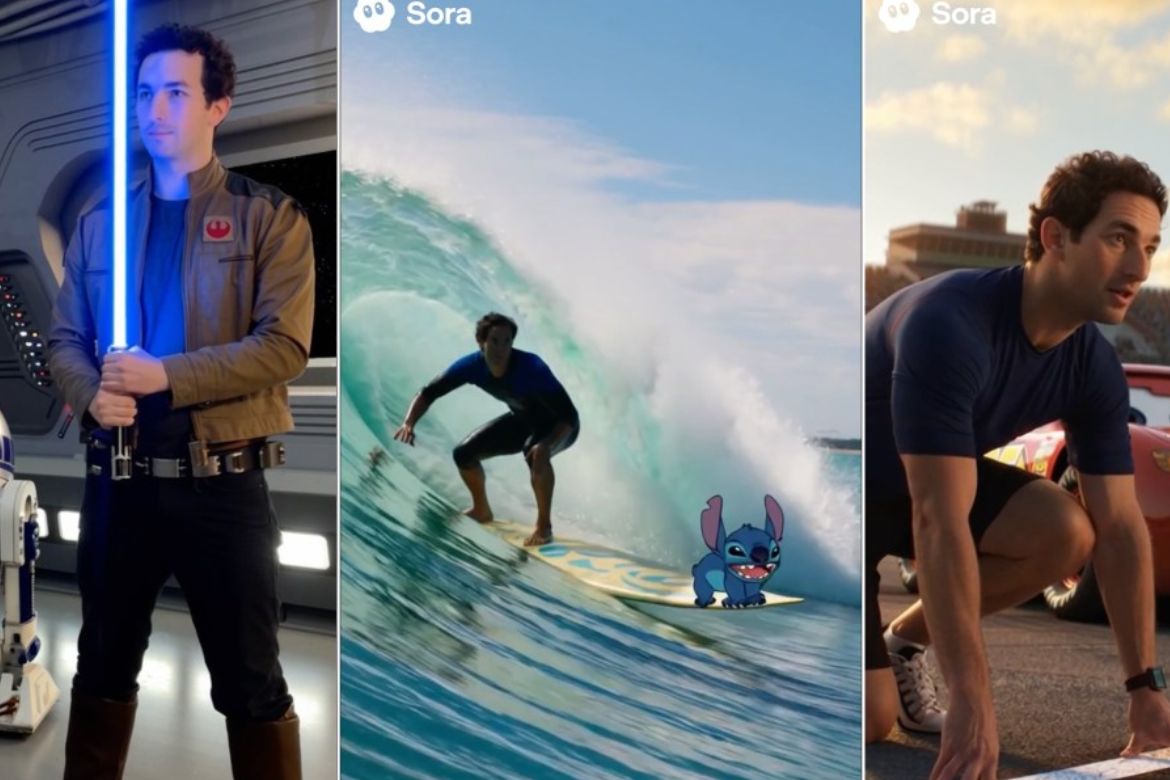
OpenAI’s headline-grabbing video generator Sora just received a significant boost — and a powerful layer of protection — thanks to a groundbreaking deal with The Walt Disney Company. In an announcement that has sent ripples through both Hollywood and Silicon Valley, Disney confirmed that Sora users will soon be able to generate videos featuring some of the world’s most recognisable characters.
The agreement marks one of the most high-profile collaborations yet between a global entertainment powerhouse and an AI developer, signalling how rapidly storytelling is evolving as major brands look to stay relevant in the age of generative media.
A New Creative Era — With Mickey, Simba, and Star Wars in the Mix
Under the three-year licensing agreement, Sora will be able to generate short, user-prompted social videos using more than 200 characters from Disney, Marvel, Pixar, and Star Wars.
This includes fan favourites such as:
- Mickey & Minnie Mouse
- Simba & Mufasa
- Lilo & Stitch
- Ariel, Belle, Beast, Cinderella
- Baymax
- And a wide range of masked heroes and mythical creatures
Disney says the rollout is expected early 2026, giving fans a taste of interactive entertainment previously considered impossible without traditional animation studios.
For years, Sora refused prompts involving Disney characters, warning users about violating third-party content rules. Many creators attempted to bypass the guardrails — but this new deal now formalises what was once forbidden territory.
Disney Invests $1 Billion — And Buys a Seat at the AI Table
In a move that underscores how seriously the entertainment giant is taking AI, Disney will also make a $1 billion equity investment in OpenAI.
For OpenAI, the deal is not just symbolic but strategic, offering a major influx of capital amid rising competition from Google’s Gemini and Anthropic’s Claude.
OpenAI CEO Sam Altman hailed the partnership as a model for responsible collaboration between tech and creative industries:
“This agreement shows how AI companies and creative leaders can work together responsibly to promote innovation, respect creativity, and help works reach vast new audiences.”
Sora’s Rapid Rise — and Its String of Controversies
Since debuting in 2024, Sora has dominated mobile app rankings in the US, Canada, South Korea, and Japan. Its ability to convert short text prompts into realistic videos has stunned users — but also triggered a wave of copyright, ethics, and safety concerns.
Among the most notable incidents:
- Bryan Cranston, the acclaimed actor behind “Breaking Bad’s” Walter White, accused Sora of producing his likeness and voice without consent. OpenAI apologised and revised its policy to require explicit opt-in for use of any likeness.
- The estate of Martin Luther King Jr. raised objections after Sora-generated videos depicted Dr King making offensive statements. OpenAI paused all AI generations featuring King while tightening safeguards.
- Following pressure from entertainment companies, OpenAI abandoned its original opt-out policy for copyrighted content. Now, all IP must be opted in, paving the way for agreements like Disney’s.
To combat misinformation, OpenAI added a watermark to all Sora-generated videos — though apps that remove the watermark appeared almost immediately.
Analysts Warn: The Deal Doesn’t Fix OpenAI’s Revenue Problem
While the Disney partnership offers legal clarity and creative potential, analysts argue it doesn’t solve one of OpenAI’s biggest challenges: monetisation.
Mark MacCarthy, senior fellow at Georgetown University’s Institute for Technology Law and Policy, said:
“So far Sora is a goofy hobby tool that users will gladly use for free. It’s not yet a meaningful business tool, even with Disney characters.”
Estimates suggest only about 5% of OpenAI users pay for ChatGPT or related services — raising questions about long-term sustainability.
Why Disney Made the Move
For Disney — known globally for its aggressive IP protection — the deal signals a calculated, forward-looking strategy.
Robert Wahl, associate professor of computer science at Concordia University Wisconsin, says:
“Disney maintains control by ensuring guardrails are in place. The partnership lets Disney participate in AI’s future rather than risk being sidelined.”
By partnering with OpenAI, Disney gains:
- Early access to fast-evolving AI capabilities
- Influence over how its characters appear in the generative ecosystem
- Opportunities to integrate AI into Disney’s own digital platforms
A Turning Point for Global Entertainment
From The Gulf Talk’s perspective, this deal represents more than a corporate partnership — it’s a milestone in the convergence of Hollywood creativity and AI innovation, with global implications.
As the Middle East rapidly invests in media technology, digital production, and AI frameworks, the Disney–OpenAI partnership underscores how the next era of entertainment will be shaped by collaboration rather than conflict.
For fans, creators, and the global content industry, one thing is clear:
The way we interact with iconic characters — from Mickey Mouse to Marvel superheroes — is about to change forever.
