

Football may dominate South American passions, but in Venezuela — the only CONMEBOL nation to have never reached a World Cup — attention has shifted to something far more ominous. While FIFA honoured former US President Donald Trump with its first-ever Peace Prize, Venezuelans are watching a very different spectacle: the steady build-up of US military power off their coastline.
For Gulf audiences, the story is familiar — energy-rich nations becoming flashpoints at moments of global tension. And once again, oil sits at the heart of the unfolding drama.
A US Armada at Venezuela’s Doorstep
In recent weeks, the US has deployed a formidable force to the western Caribbean:
- The USS Gerald R. Ford aircraft carrier
- Multiple warships and amphibious vessels
- Warplanes
- Around 16,000 troops and naval personnel
- Renewed construction at an old naval base in Puerto Rico
On November 29, Washington declared Venezuelan airspace “closed”, raising alarms in Caracas and across the region.
Unlike previous US interventions in Grenada (1983) or Panama (1989), Venezuela’s size — 28.5 million people — and its geography make any potential conflict vastly more complex. Even the 2003 Iraq invasion required 160,000 troops and years of post-conflict turmoil, despite similar population size.
What Does Washington Want? No Single Answer — And That’s the Problem
Inside the US administration, priorities often blur. Analysts see five overlapping motivations:
1. Drug enforcement
Though Venezuela is not a major source of US-bound narcotics.
2. Migration control
A military showdown would likely worsen, not reduce, refugee flows.
3. Ideological confrontation
Anti-socialism remains a powerful domestic rallying point in parts of the US.
4. Regional dominance
The new US national security strategy warns against foreign powers gaining influence in the Western Hemisphere.
5. And yes — oil
Always oil.
Trump reportedly gave President Nicolás Maduro a direct ultimatum to step down during a call on November 21. Some in Washington hope Nobel Peace Prize laureate María Corina Machado could take the helm. Others suspect Trump wants quick political wins or leverage before shifting to the next geopolitical battle.
Foreign Powers Already Embedded in Venezuela’s Oil Fields
From a Gulf perspective, the geopolitical landscape is striking.
- Russia’s Rosneft is heavily invested in the Orinoco Belt.
- China National Petroleum Corporation (CNPC) remains a key partner.
- Iran supplies light crude to dilute Venezuela’s extra-heavy oil.
- Chevron still operates in the country under temporary US sanctions waivers.
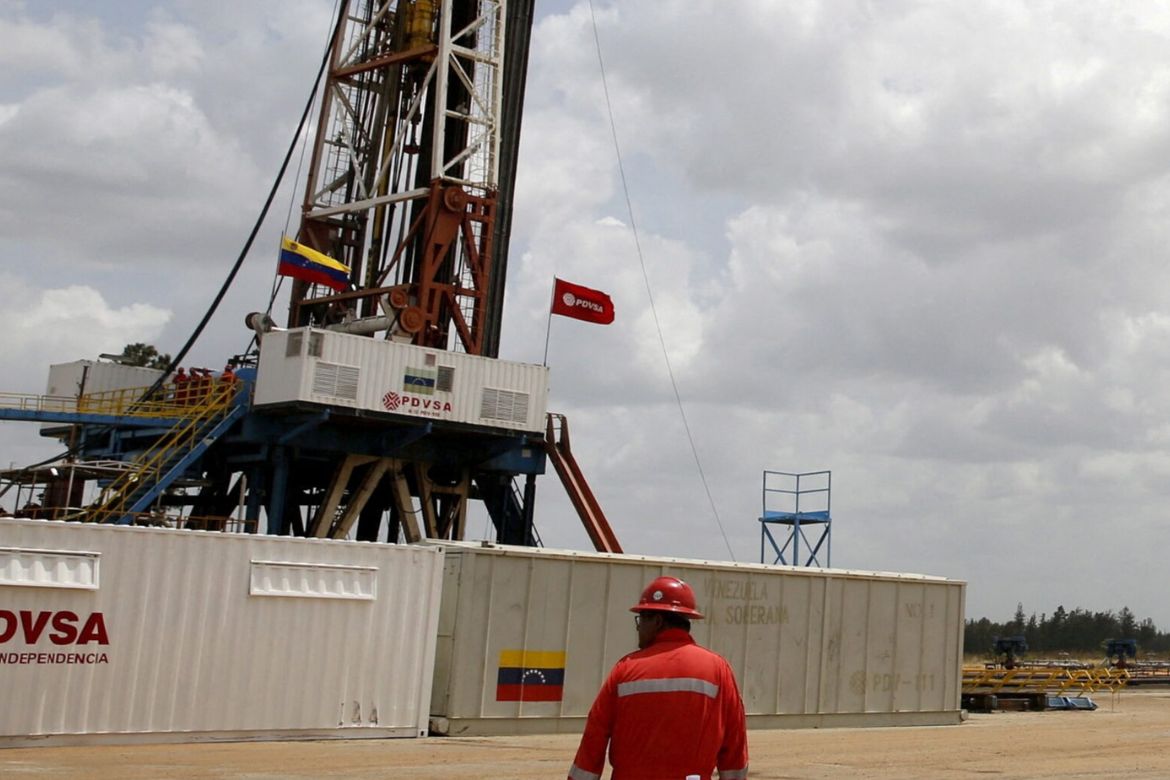
Most of Venezuela’s 750,000 barrels per day of exports head to China, not the US.
The optics are powerful: Venezuela as a foothold for America’s global rivals — a narrative Washington appears eager to counter.
Oil: Prize, Burden, or Mirage?
Maduro has publicly accused Washington of seeking to seize “the largest oil reserves on the planet”.
Machado, meanwhile, speaks of a $1.7 trillion re-industrialisation opportunity and has floated the idea of privatising PDVSA.
Some US lawmakers are even more blunt. Congresswoman María Salazar celebrated the idea of a “field day” for American oil companies — worth “more than a trillion dollars” — if Venezuela’s petroleum sector were opened to US control.
But beneath the headline figure of 303 billion barrels of reserves, lies a tougher truth:
- Most Venezuelan crude is extra-heavy, sulphur-rich, and costly to produce.
- Mismanagement, corruption, brain drain, and sanctions have gutted the once-powerful oil industry.
- Output collapsed from 2 million barrels/day in 2015 to under 1% of global production today.
Even with stability, rebuilding would require years. In the aftermath of conflict or forced regime change, it could collapse further — driving regional instability and complicating US attempts to keep domestic fuel prices low.
A Country in Decline, But Not a Blank Cheque
Venezuela desperately needs political renewal. Once Latin America’s wealthiest nation, it has fallen into deep poverty despite its natural riches. The return of skilled diaspora talent and responsible governance will be crucial to any revival.
But history is not kind to oil-rich states subjected to foreign intervention. The Gulf knows well how external powers can ignite instability, fracture institutions, and distort the very sectors meant to deliver prosperity.
For all the rhetoric, Venezuela’s oil is not the easy treasure it appears on paper. Foreign companies might profit in the short term, but the broader costs — economic, political, humanitarian — could be immense.
As the US military presence grows and diplomatic signals tighten, Venezuela stands at a dangerous crossroads. And once again, the world is reminded that where vast oil reserves exist, geopolitical storms are never far behind.
