

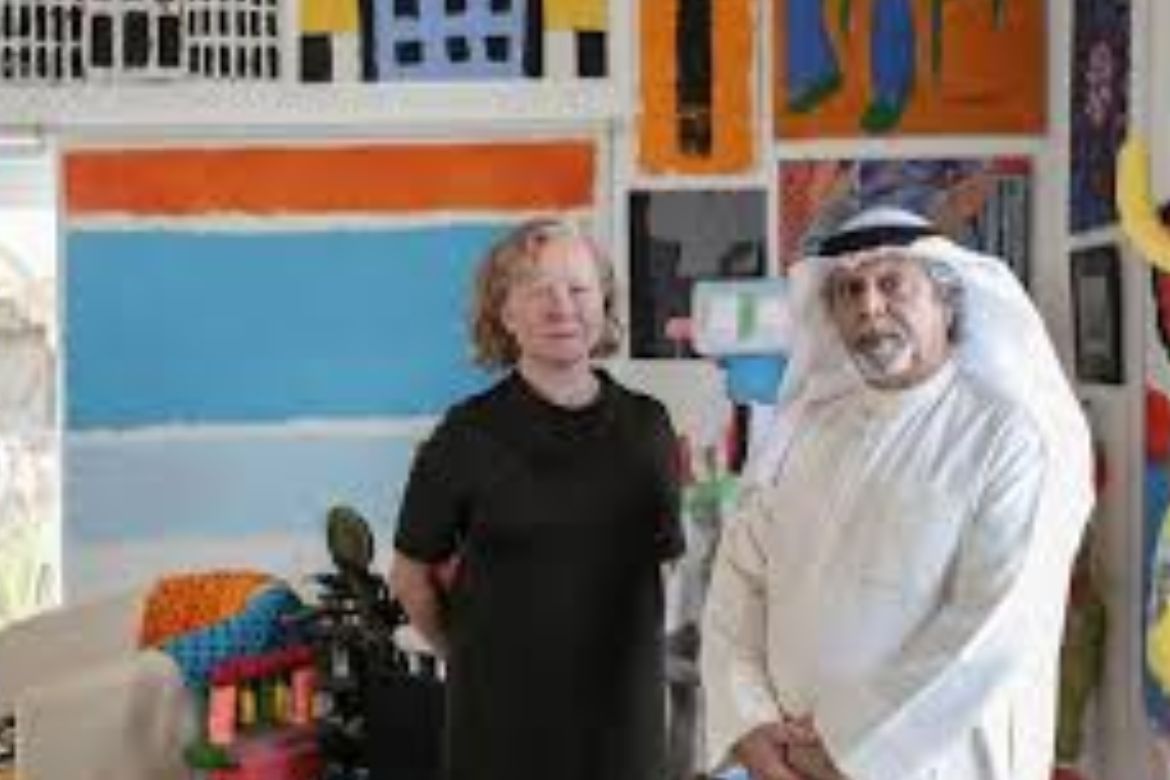
Today, Mohamed Ahmed Ibrahim stands globally recognised as a founding force of contemporary Emirati art, with works housed in major institutions including the Guggenheim Foundation. But long before acclaim reached him, he faced a moment so severe that it nearly ended his artistic journey altogether.
In the late 1990s, overwhelmed by an inner collapse he calls a “Bermuda Triangle within,” Ibrahim loaded two truckloads of his early artworks — paintings, drawings, and experimental forms — and drove them deep into the mountains of Khor Fakkan. There, in a symbolic act of despair and rebirth, he set the entire archive on fire.
“I reached a stage where I didn’t know where my work belonged,” he says. “Dust to dust — the works came from the mountains and returned to the mountains.”
What could have been the end became the turning point. By the very next morning, Ibrahim was creating again — but with a new clarity and a boldness that would define his next decades.
His art, once misunderstood by local audiences, became deliberately provocative and unapologetically experimental. And despite the societal disconnect, Ibrahim was not alone. A tight circle of like-minded artists — Hassan Sharif, Hussein Sharif, Abdullah Al Saadi, and Mohammed Kazem — were carving out a new visual language for the UAE.
This group, later known as “The Five,” would become the backbone of contemporary Emirati art. Their discussions, their friendship, and their shared hunger for experimentation built a creative ecosystem long before the country had museums, universities, or formal art infrastructure.
For Ibrahim, the journey began in solitude. Art books mailed from the UK and his psychology studies at Al Ain University nurtured a mind that saw “the discourse behind the image.” His early practice emerged from the raw textures and colours of Khor Fakkan — cliffs, corals, earth, and sea — elements that continue to shape his visual vocabulary.
Everything shifted in 1986 when Ibrahim met the late Hassan Sharif, a pivotal mentor who opened the doors to a new world of conceptual and experimental practice. Their collaborations ignited a movement that would later represent the UAE on global platforms — including multiple appearances at the Venice Biennale. In 2022, Ibrahim presented his landmark solo exhibition Between Sunrise and Sunset, featuring 128 organic sculptural forms crafted from earth, leaves, coffee, tobacco, and handmade papier-mâché.
Today, Ibrahim’s story continues at the Cultural Foundation Abu Dhabi. His expansive exhibition, Two Clouds in the Night Sky, presents a rare overview of his decades-long practice — from the totemic sculptural forests he is known for to his famous Sitting Man series inspired by an accidental headless photograph of Hassan Sharif.
The show unfolds like a surreal garden, alive with papier-mâché creatures, bottle-sculptures, and paintings echoing Khor Fakkan’s rugged terrain. Children, he notes, often connect most deeply with the work — drawn to its colours, playfulness, and dreamlike forms.
“I see it as a garden,” he says. “Seeing the works in a space creates a dialogue with yourself. It confirms your conviction.”
Despite his international travels — from Cairo’s Al Shesheini Street to Kochi, Kathmandu, Sittard, and Dijon — the UAE remains his creative bedrock. His hopes for the next generation have already been fulfilled: a thriving Emirati art community, global exhibitions, and robust cultural institutions.
“I’m very happy when I see young artists working with passion,” he says. “They’re all dear to me. We just needed time — and now we have it.”
Looking ahead, Ibrahim plans to establish a foundation: a private studio, a communal space, and a creative home for emerging Emirati artists to experiment freely — just as he once did in secret drawers during his day jobs.
From the ashes of self-destruction came reinvention. From solitude came a movement. And from Khor Fakkan emerged one of the UAE’s most influential artistic voices.
