

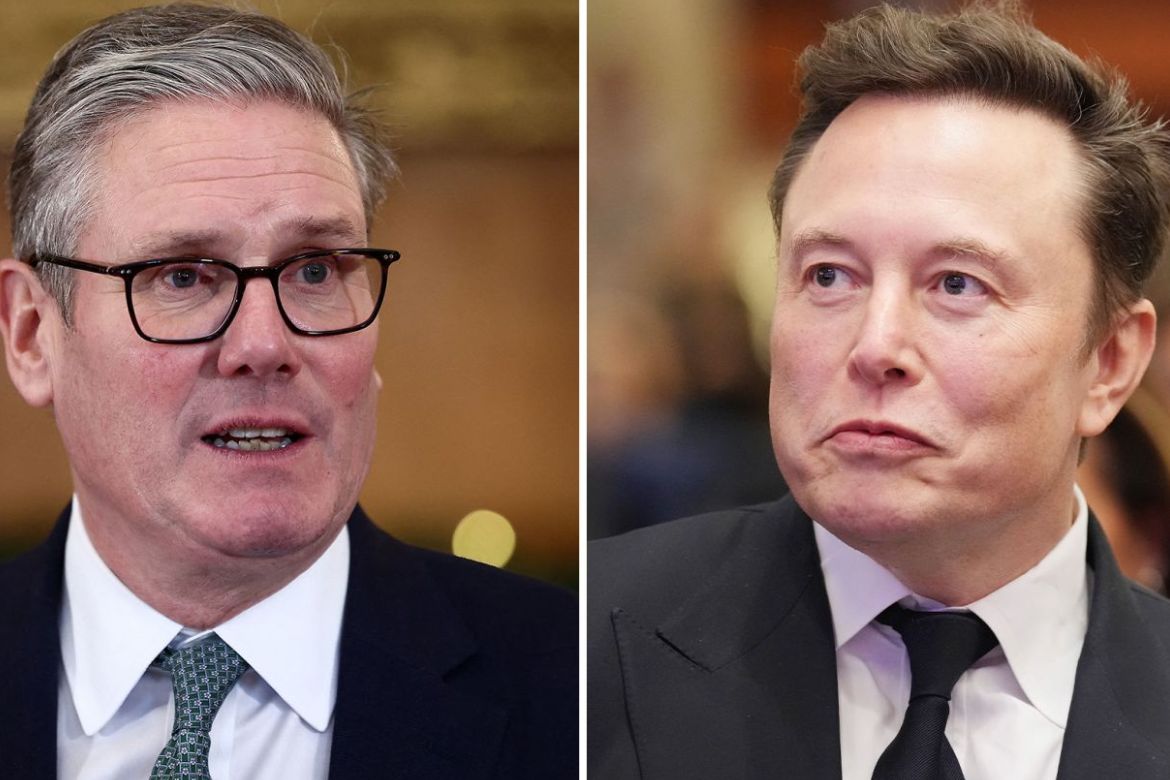
On Saturday afternoon, British Prime Minister Keir Starmer sought respite at London’s Emirates Stadium, where Arsenal swept aside Nottingham Forest. But beyond the executive box, the colours of red and white—the same hues that fill the England flag—were being weaponised in a very different arena. Just a short distance from Downing Street, the cross of St George had become the rallying banner of Britain’s growing ultra-right.
Tens of thousands marched against Starmer’s government under that flag. The day ended in violence: clashes with police, attempts to break through to anti-racist counter-protesters in Trafalgar Square, and 26 officers hospitalised. The spectacle underscored how volatile Britain’s political climate has become.
A Globalised Ultra-Right
Observers in London, including The Gulf Talk, noted how international forces are fuelling the unrest. Among the crowd were muscular, black-clad members of New Zealand’s Destiny Church, a radical evangelical group. They performed a traditional haka to whip up the marchers before their leader, Brian Tamaki, called for a “religious war” and openly demanded bans on Islamic, Hindu, Bahá’í, and Buddhist practices. His message was stark: only Christianity should be visible in public life.
The rally was organised by far-right activist Tommy Robinson under the slogan Unite the Kingdom. While Robinson branded it a “free speech festival,” the tone was one of division, resentment, and confrontation—fuelled by months of protests outside hotels housing migrants.
The event also revealed the global links of the far-right. Video addresses poured in from Elon Musk, French polemicist Éric Zemmour, and Ezra Levant of Canada’s Rebel News. Activists travelled from across Europe and beyond, from Poland and Germany to Spain, Belgium, Ireland, and New Zealand. Their coordinated presence shows that Britain’s far-right does not operate in isolation but is tapping into a transnational grievance network.
Starmer’s Political Dilemma
For Starmer, the timing is difficult. Barely 15 months into office, his government already appears bogged down by economic stagnation and internal Labour hesitations over his growth agenda. Poll numbers show him slipping, echoing the troubles that plagued his Conservative predecessors.
In response to the violence, Starmer stood on the steps of Downing Street to condemn the attacks on police and the intimidation of people for their skin colour or background. He insisted that the England flag “represents our diverse country” and would never be handed over to extremists as a symbol of “violence, fear and division.”
Yet there is a question of credibility. The meme of “Operation Raise the Colours”, which has seen St George’s Crosses and Union Jacks suddenly multiplying on homes and streets, highlights how quickly national symbols are being co-opted. If his government resists too aggressively, it risks validating the far-right’s narrative of a free speech struggle—an angle amplified by American and European allies of Robinson.
Why This Matters Beyond Britain
For Gulf readers, this confrontation is not distant political theatre. London is home to significant Arab, Asian, and Muslim communities. The Gulf’s strong educational, business, and cultural links with the UK mean instability directly affects our citizens. Last week, several embassies—including the UAE’s—advised caution to their nationals in the capital. Police urged London’s Muslims to continue normal routines, but the unease is real.
The fact that Elon Musk used the rally to call for Starmer’s downfall and warn that “violence is coming” shows how disruptive global figures can be in amplifying unrest. For Gulf states, which value stability, security, and interfaith coexistence, the images from central London are troubling reminders of how quickly intolerance can destabilise a multicultural society.
Holding the Line
Starmer is trapped between an emboldened ultra-right movement and the need to prove his government can deliver economic renewal. But as The Gulf Talk sees it, the bigger test is not simply political survival—it is about whether Britain can defend its diverse social fabric against forces seeking to unravel it.
The UK prides itself on being a global hub for education, trade, and culture—links that the Gulf shares deeply. If its government falters, the consequences will ripple far beyond Westminster. For Starmer, the challenge is clear: he must hold the line, not only for Britain’s democracy but for the international partners and communities who depend on its stability.
