

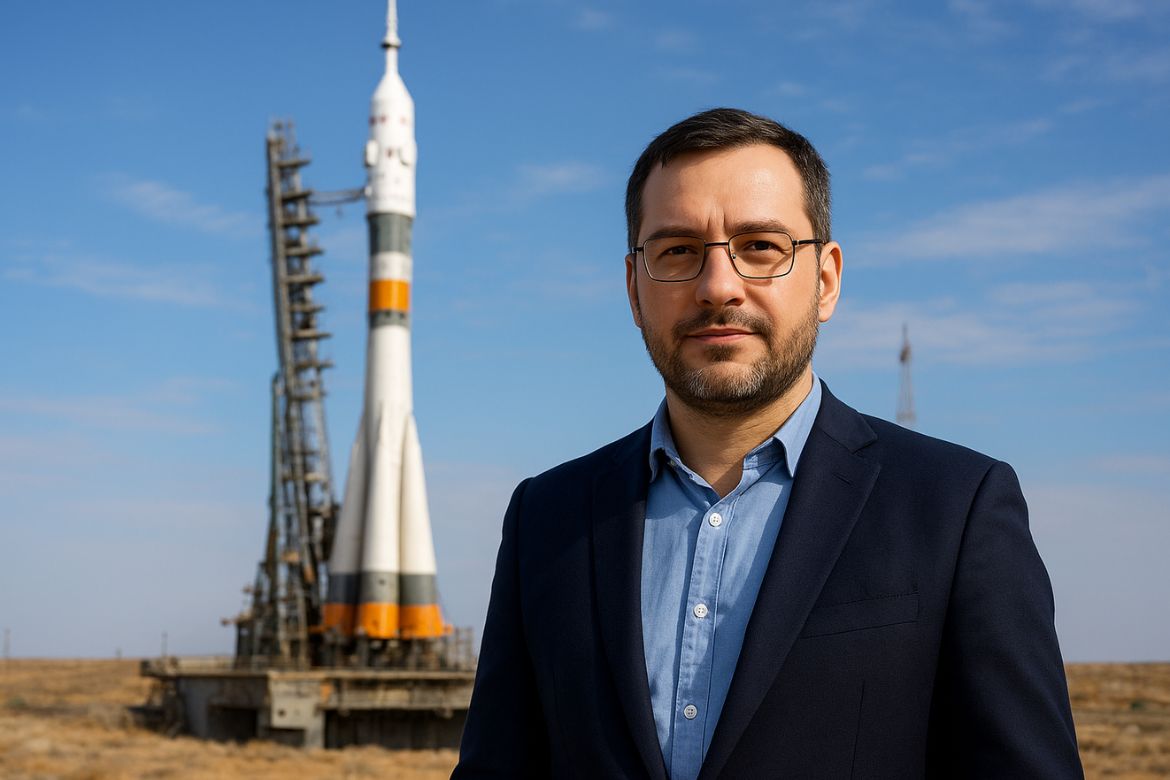
At The Gulf Talk, we often spotlight the region’s boldest innovators — but few stories bridge past and future as powerfully as that of Stan Rudenko, the Abu Dhabi-based entrepreneur who grew up in the shadow of the Soviet Union’s most secretive space city. Today, he is on a mission to build a new generation of rockets in the UAE, reshaping the Arab world’s role in global spaceflight.
A Childhood Framed by Launch Towers
As a young boy in Baikonur, the world’s largest and most iconic spaceport, Rudenko’s daily walk to school took him past a towering, full-scale Soyuz launcher. His town existed for one purpose — to serve the Soviet space programme. Engineers, cosmonauts and space scientists filled its streets, and statues honouring legendary space pioneers stood as symbols of national pride.
Now 42, and the chief executive of Aspire Space in Abu Dhabi, Rudenko still remembers the ground-shaking roar of rockets lifting off just kilometres away. His father played a major role in the Zenit launch system, embedding the family deeply into the story of Soviet-era rocketry.
“Our whole life revolved around launches,” he recalled. “I remember watching the Buran spaceplane land with fighter jets escorting it — the entire nation felt victorious.”
When the Space Empire Fell
Baikonur was the beating heart of the Soviet space dynasty — the birthplace of the first satellite and the launch site of the first human in space. But everything changed after the collapse of the Soviet Union in 1992. As Kazakhstan became independent, budgets shrank, operations scaled down, and thousands of families — including Rudenko’s — left the once-thriving rocket city.
Despite the deep influence of spaceflight on his childhood, Rudenko initially pursued a different destiny. He graduated from a top law school in St Petersburg and worked in multinational firms across Europe.
But as he often says now, life eventually pulled him back to rockets.
Building the UAE’s First Fully Reusable Rocket System
Aspire Space, originally based in Luxembourg, has now relocated to the UAE — a move that signals confidence in the Emirates’ accelerating aerospace vision. The company’s goal is bold: to manufacture rockets completely within the UAE.
Its flagship project, Oryx, is a fully reusable, two-stage orbital transportation system designed for:
- deploying satellites
- resupplying space stations
- conducting in-orbit scientific missions
- returning cargo safely back to Earth
Unlike most reusable rockets, where only the booster is recovered, Oryx is built so both stages return to Earth.
“It’s a fully reusable rocket ship,” Rudenko said. “The upper stage is a real spacecraft capable of conducting multiple missions before returning home. The launch is just the beginning.”
He believes this model will unlock a new era of cost efficiency in space access.
“It’s neither economical nor sustainable to throw expensive hardware into the ocean,” he said. “Reusability must return value to the economy.”
Oryx will be powered by methalox engines developed with Dubai-based Leap 71, known for its artificial-intelligence-powered propulsion design.
Aspire’s engineering roster reads like a who’s who of Soviet heavy-lift history, including veterans from Zenit, Energia–Buran, and Sea Launch — the same programmes that defined an era of space innovation.
Chief technology officer Sergey Alekseevich Sopov explained it simply:
“Reusability is an engineering culture. Every structural component and avionics block must be designed for traceability, durability and rapid reflight. In a reusable system, there are no small parts.”
Launch Ambitions in the UAE and Kazakhstan
Aspire Space plans to operate two launch sites:
- A UAE launch site, giving the Emirates true sovereign access to orbit
- A Kazakhstan site, ideal for high-frequency commercial missions due to well-established flight corridors
Rudenko confirmed that discussions for the Emirati launch site are ongoing. Kazakhstan, with its long history as a launch hub, remains the logical choice for frequent early missions.
The company is also “watching very closely” the development of Oman’s Etlaq Spaceport, positioning itself to leverage emerging Gulf regional launch infrastructure.
Aspire is now working to establish a complete manufacturing and testing ecosystem in the UAE, including:
- advanced engine test stands
- full-stage testing facilities
“We have an ambitious timeline for hardware fire-testing,” Rudenko said. “These facilities are absolutely essential.”
Aspire’s rocket model will be showcased at the UAE Space Pavilion during the Dubai Airshow from November 17 to 21, offering the world a first look at the system that could redefine the UAE’s place in the global space economy.
A Story That Connects Emirates Ambition With Space History
From the closed streets of Baikonur to the open horizons of Abu Dhabi, Stan Rudenko’s journey reflects something uniquely powerful: the fusion of Soviet engineering heritage with Gulf innovation and ambition.
At The Gulf Talk, we see Aspire Space as a symbol of the UAE’s next great leap — a future where rockets are not only launched from the Emirates, but designed, built and reused here.
