

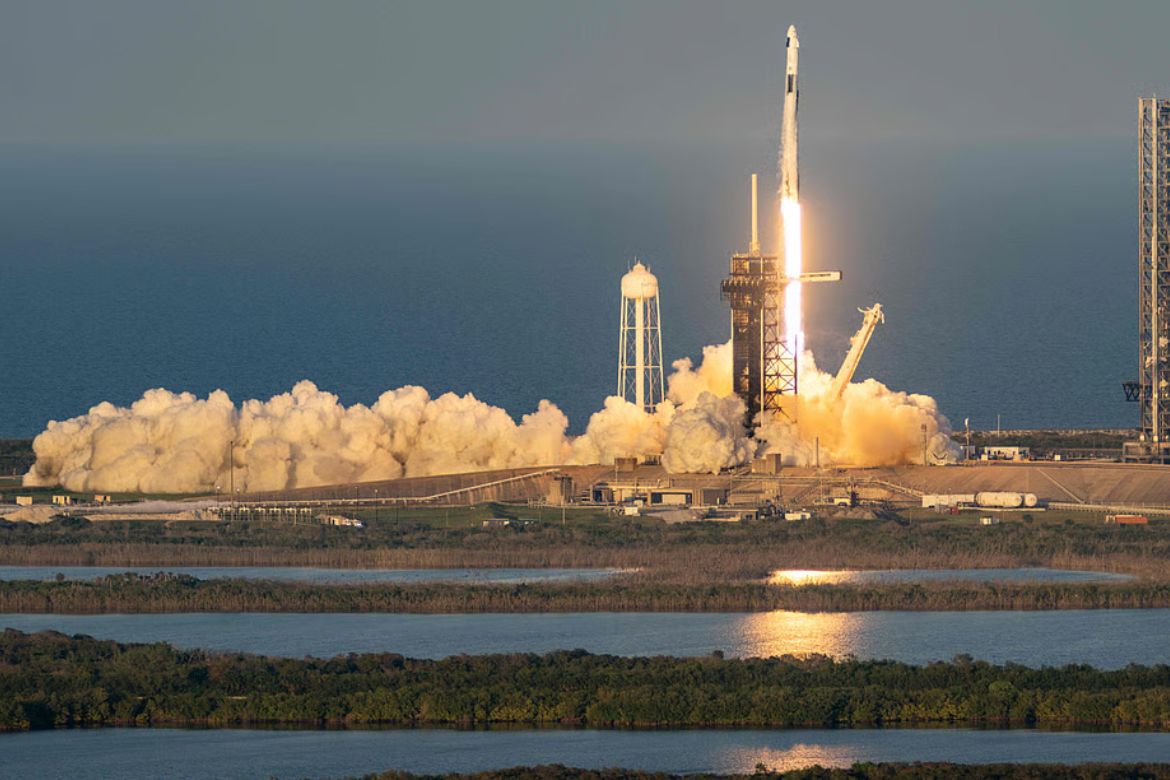
Long before the UAE set its sights on Mars and the Moon, Stan Rudenko was growing up in the shadow of rockets.
As a boy, his walk to school took him past a full-scale Soyuz launcher in a town built exclusively to serve the Soviet Union’s vast space programme. Engineers, astronauts and launch crews defined daily life, while monuments to space pioneers stood on nearly every street corner. Rocket launches were not rare events — they were routine.
Today, at 42, Mr Rudenko is the chief executive of Aspire Space, an Abu Dhabi–based aerospace company aiming to place the UAE among the world’s elite spacefaring nations by developing fully reusable orbital rockets made in the Emirates.
He still vividly remembers the thunderous launches from Baikonur Cosmodrome in Kazakhstan, where his father played a senior role in the Zenit space programme.
“Our entire life revolved around launches,” Mr Rudenko told The Gulf Talk. “I clearly remember the Buran orbital spaceplane landing, escorted by fighter jets. It felt like a moment of national triumph.”
Baikonur was once the beating heart of the Soviet space empire — the launch site of the world’s first satellite and the first human in space. But following the collapse of the Soviet Union in 1992 and Kazakhstan’s independence, activity declined sharply. Like many families, the Rudenkos eventually left the once-thriving rocket town.
Despite a lifelong fascination with space, Mr Rudenko initially chose a different path. He graduated from a leading law school in St Petersburg and built a successful career with multinational firms before being drawn back to the industry that shaped his childhood.
“Life brought me back to rockets,” he said. “Now we’re working with some of the most experienced engineers in the world.”
A Rocket Built for the UAE
Originally founded in Luxembourg, Aspire Space has since relocated its headquarters to the UAE and plans to manufacture its rockets entirely within the country — a major step toward sovereign space capability.
The company’s flagship project, Oryx, is a two-stage, fully reusable orbital transportation system designed for satellite launches, space station resupply, in-orbit laboratory missions and cargo return to Earth.
Unlike conventional reusable rockets that recover only the first-stage booster, Oryx is designed so both stages return safely, dramatically improving sustainability and lowering long-term costs.
“This is not just a launcher — it’s a reusable rocket ship,” Mr Rudenko said. “The second stage functions as a spacecraft capable of complex orbital missions before coming back to Earth. Launch is only the beginning.”
He believes true reusability will transform space economics by increasing launch frequency and reducing costs, much like commercial aviation.
“It makes no sense to sink expensive hardware into the ocean,” he said. “Reusability has to work for the economy.”
Oryx will be powered by methalox engines using liquid methane and liquid oxygen, developed in partnership with Dubai-based Leap 71, which uses artificial intelligence to design advanced propulsion systems.
Aspire’s engineering team includes veterans from historic programmes such as Zenit, Energia–Buran and Sea Launch, bringing decades of heavy-lift and reusable spaceflight experience.
Chief technology officer Sergey Alekseevich Sopov said the rocket’s design reflects lessons learned over generations of space engineering.
“Reusability is not just about landing a rocket,” he said. “It’s about returning its value to the economy.”
Every component, he added, is designed with service life, digital traceability and rapid turnaround in mind.
“In a reusable system, there are no small parts,” Mr Sopov said.
Launch Sites and Regional Strategy
Aspire plans to operate two launch sites — one in the UAE to ensure sovereign access to space, and another in Kazakhstan to support high-frequency commercial missions using established flight corridors.
While discussions over a UAE launch site are ongoing, Mr Rudenko said Kazakhstan currently offers the infrastructure needed for frequent launches. Oman’s emerging Etlaq spaceport is also being closely monitored as a potential future option.
The company aims to build a full manufacturing and testing ecosystem in the UAE, starting with engine test facilities and full-stage test stands.
“We have an ambitious timeline for firing real hardware,” Mr Rudenko said. “These facilities are essential to making the UAE a true space manufacturing hub.”
Aspire Space will showcase a model of its Oryx rocket at the UAE Space Pavilion during the Dubai Airshow from November 17 to 21.
For the UAE, already recognised for its Mars and lunar missions, Aspire’s vision represents a critical next step: independent, homegrown access to orbit — built in the Emirates and launched from the region.
