

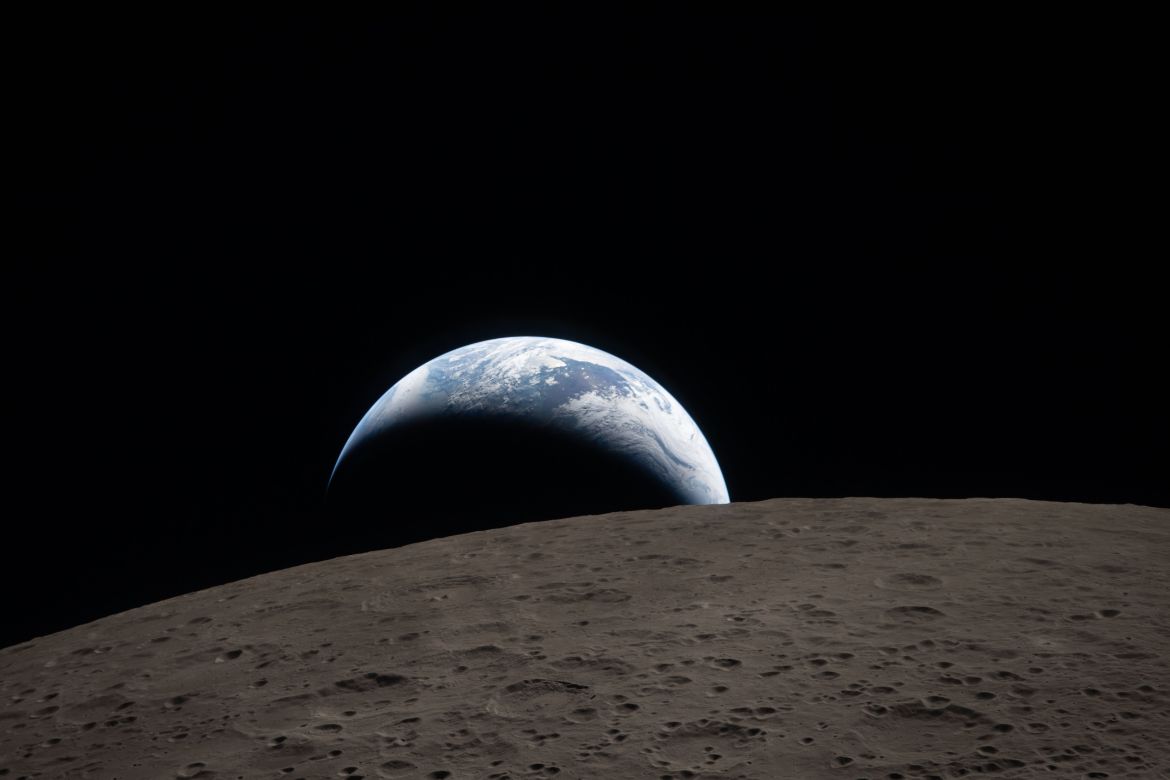
In 1968, astronaut William Anders captured one of the most powerful images in history—Earth rising above the Moon’s horizon. Taken during Apollo 8, the photograph, later known as “Earthrise,” transformed how humanity viewed its place in the universe.
Today, that moment is set to come full circle.
More than 50 years later, NASA is preparing to send astronauts back to lunar orbit through the Artemis II mission—marking a major step toward restoring human presence in deep space.
The 10-day mission will carry four astronauts—Reid Wiseman, Victor Glover, Christina Koch, and Jeremy Hansen—on a journey of more than 640,000 km, the farthest distance humans have travelled from Earth.
Artemis II stands out not only for its technical ambition but also for its representation. It will include the first woman and the first African American astronaut to orbit the Moon, while Hansen will become the first non-American to take part in such a mission—highlighting a new, more inclusive era of space exploration.
At the centre of the mission is the Orion spacecraft, a next-generation capsule designed for deep-space travel. Paired with the powerful Space Launch System rocket, Orion brings significant advancements over the Apollo-era spacecraft, including improved life-support systems, enhanced safety, and vastly superior computing capabilities.
The mission is also a testament to global collaboration. NASA is working alongside partners such as the European Space Agency, reflecting a shift from the competitive space race of the past to a more cooperative, international approach—one that resonates with the Gulf region’s growing ambitions in the space sector.
Since Yuri Gagarin first journeyed into space in 1961, only a small group of astronauts have ventured as far as the Moon. Artemis II aims to change that, reopening deep space for human exploration and setting the stage for future lunar landings and eventual missions to Mars.
As the world looks ahead, Artemis II represents more than a return—it marks the beginning of a new chapter. One where technology, diversity, and global partnerships come together to push the boundaries of what humanity can achieve beyond Earth.
