

Uzbekistan today is a nation suspended between dust and glass. The first sensation upon arrival in the capital is not visual but visceral: the metallic tang of smog in the air of a city undergoing rapid transformation. Ancient Tashkent, levelled and rebuilt repeatedly over centuries, is once again in flux. Skyscrapers rise at remarkable speed, cranes punctuating the skyline, while construction haze settles as the visible cost of progress.
This moment marks a strategic turning point. Uzbekistan is investing billions of dollars into tourism and infrastructure as it repositions itself as the cultural and historical anchor of Central Asia. Once sealed off to outsiders during the Soviet era and largely inaccessible to global travellers until little more than a decade ago, the country is now actively opening its doors—using its imperial past as both foundation and fuel for the future.
A Capital Reinventing Itself
Modern Tashkent reflects this recalibration. High-end hotels, new transport links and exclusive social spaces signal the emergence of a confident urban elite. From rooftop venues such as Gravity Bar at the Sapiens Hotel, the contrast is unmistakable: mosque minarets rise beside LED billboards, while Soviet-era geometry meets contemporary glass-and-steel ambition.
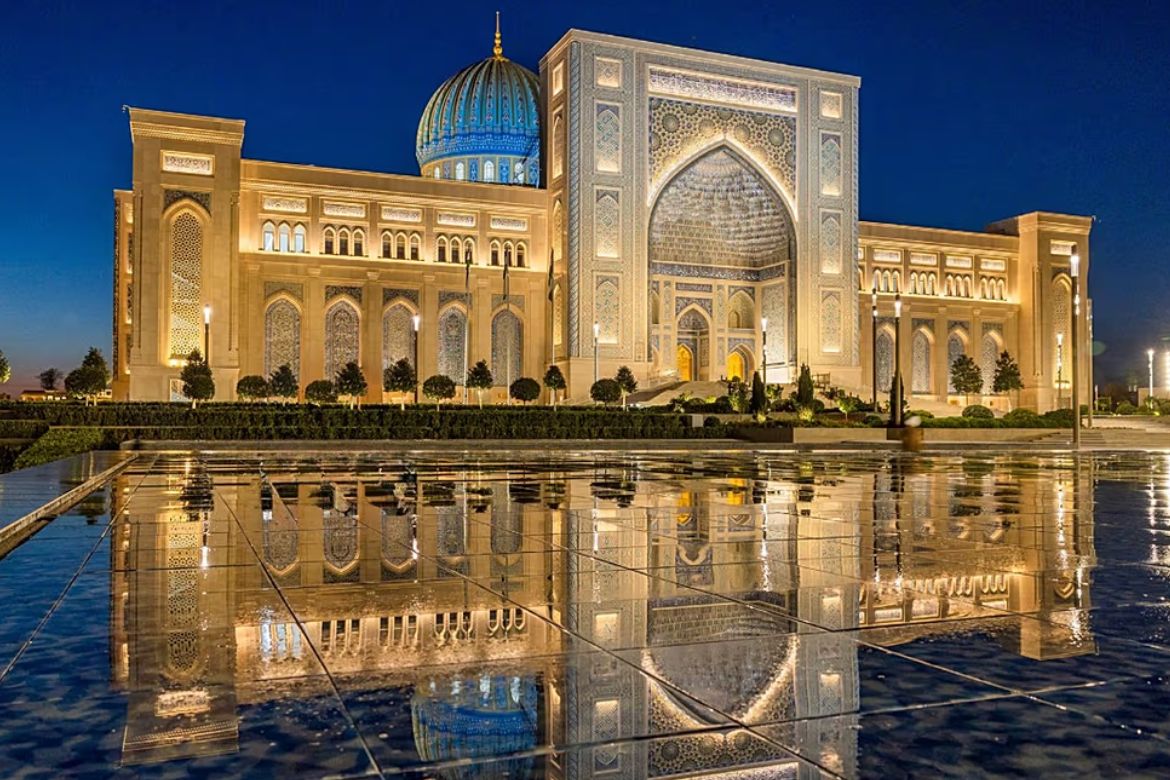
Yet history remains central to the narrative. At the Hazrati Imam complex, the Centre for Islamic Civilisation stands as a powerful cultural statement. Its centrepiece, the 8th-century Uthman Quran—among the oldest in existence—was brought to the region by Amir Timur, known internationally as Tamerlane. Six centuries later, his legacy dominates Uzbekistan’s national identity.
Following independence, Timur replaced Karl Marx as the symbolic figurehead of the nation. His statues now anchor city squares, projecting strength, unity and historical continuity. In Tashkent, he appears in perpetual motion, mounted and commanding. But it is in Samarkand, the former capital of his empire, where his presence is most deeply felt.
Samarkand: Imperial Memory Preserved
Connected to Tashkent by the high-speed Afrosiyob train, Samarkand remains Uzbekistan’s most potent symbol of imperial power. Its cuisine alone is a point of pride: Samarkand plov, served in precise, layered form, is treated less as a meal than as cultural architecture.
The Gur-e-Amir mausoleum, Timur’s final resting place, offers a striking contradiction. The conqueror responsible for vast destruction across Asia chose to be buried humbly, at the feet of his Sufi teacher rather than elevated above his lineage. It is a detail that complicates the mythology of power.
Nearby, Registan Square—one of the most celebrated public spaces in the Islamic world—has become a stage for controlled modern spectacle. Night-time projections trace Uzbekistan’s layered history across earthquake-shifted madrasas, balancing technological ambition with architectural reverence.
The city’s Shah-i-Zinda necropolis tells another story: of craftsmanship, faith and continuity. Its blue-tiled mausoleums climb the hillside in defiant colour, standing alongside Soviet-era restorations that replicate form but lack the subtle mastery of the originals. For pilgrims, ritual remains central—counting steps up and down the complex in hopes of fulfilled wishes.
Bukhara: Power, Brutality and Survival
If Samarkand represents preservation, Bukhara reflects endurance through loss. The Ark fortress—once a self-contained royal citadel—stands today as a fractured monument, partially destroyed during a Russian aerial assault in 1920. It is here that imperial narratives turn darker.
For British readers, Bukhara holds particular historical weight. During the 19th-century Great Game, British officers Charles Stoddart and Arthur Conolly were imprisoned, tortured and ultimately executed by the Emir of Bukhara, victims of rigid protocol and imperial rivalry. Their deaths remain emblematic of the region’s resistance to foreign interference.
The city’s Kalon minaret looms as a reminder of authoritarian rule, once used for public executions. Nearby market domes demonstrate architectural ingenuity, designed to amplify the sound of commerce—ensuring no transaction went unseen or unheard. Beyond the city centre, the Sitorai Mohi-Hosa palace reveals Russian imperial influence, its opulence still patrolled by peacocks roaming manicured grounds.
Beyond Islam: Deeper Civilisations
Uzbekistan’s heritage extends further still. The Samani Mausoleum, with its intricate pre-Islamic brickwork rooted in Zoroastrian design, offers rare architectural contrast. In Bukhara, where timber was scarce, wooden structures such as the Bolo-Hauz Mosque became declarations of wealth and power. Historical accounts suggest carpets were once laid across streets so the Emir could walk barefoot to prayer without touching dust.
Khiva: The End of the Line—For Now
Khiva, reached today by a long overland journey soon to be replaced by high-speed rail, feels like a frontier city. Its walled old town, Itchan Kala, glows under night skies, its blue towers illuminated against the surrounding desert. Newly opened hotels now cater to a growing luxury tourism market, signalling Khiva’s imminent integration into Uzbekistan’s national revival.
Inside the walls, legends abound. Craftsmen were reportedly killed to prevent their techniques from being replicated elsewhere. The mausoleum of Pahlavan Mahmoud—warrior, poet and patron saint—stands as the city’s spiritual and cultural centre. For now, Khiva remains a threshold before the vast Karakum Desert. Soon, it will be a key link in a seamless four-city circuit.
A Future Built on the Past
Returning to Tashkent, the contradictions become impossible to ignore. Construction cranes dominate the skyline while Timur’s statues guard shopping districts. Ancient trade routes are reborn as high-speed rail corridors. Uzbekistan is not erasing its past—it is monetising, restoring and reframing it.
For a Gulf audience accustomed to rapid transformation, Uzbekistan’s trajectory feels familiar. Like the region’s own cities, it is balancing heritage with ambition, identity with globalisation. The dust will eventually settle. The cranes will move on. But Uzbekistan’s story—of empire, collapse and reinvention—remains very much in motion.
