

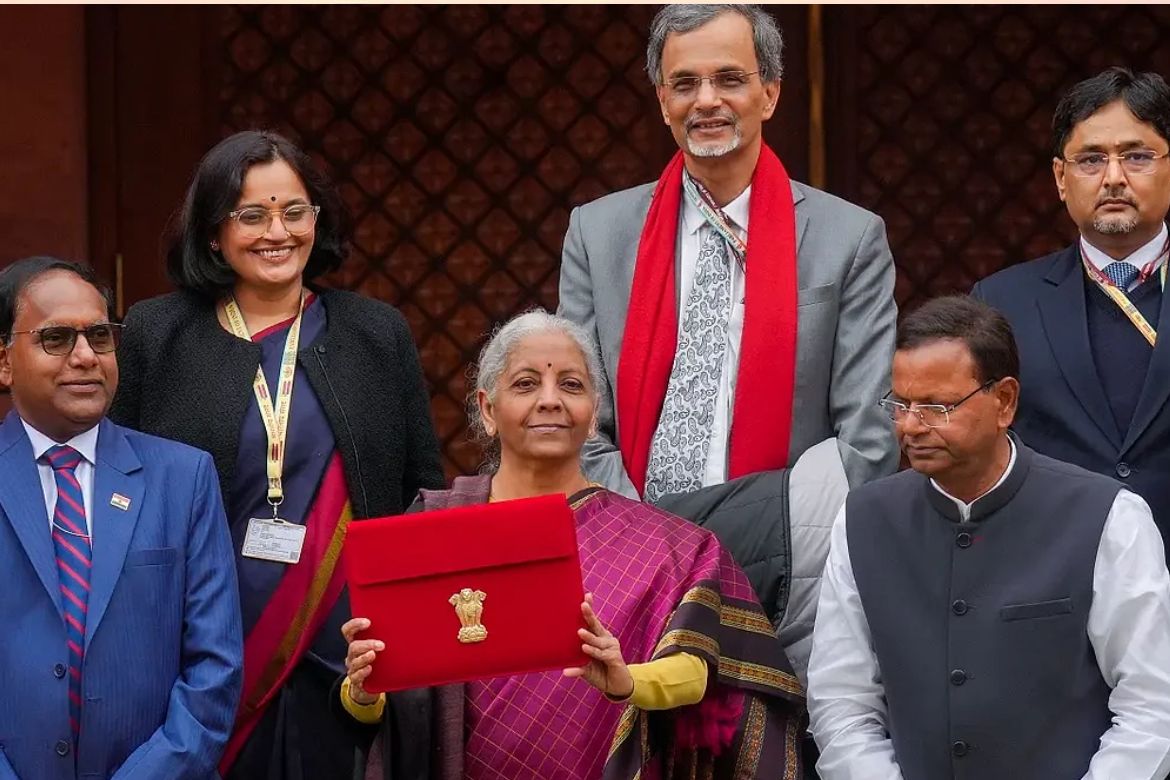
India has outlined a growth-driven Union Budget aimed at sustaining strong economic momentum, with Finance Minister Nirmala Sitharaman announcing a record increase in infrastructure spending as the country presses ahead with structural reforms in a volatile global environment.
Presenting the budget, Ms Sitharaman said infrastructure investment will rise to ₹12.2 trillion ($133.08 billion) in the 2026–27 financial year, surpassing the ₹11.21 trillion allocated for the current fiscal year — previously the highest on record. The government said the spending plan prioritises long-term competitiveness, a stronger financial system, and accelerated investment in cutting-edge technologies, including artificial intelligence.
The increased outlay comes as India seeks to maintain momentum in one of the world’s fastest-growing major economies while managing fiscal pressures and external risks. According to Reuters, India’s economy is projected to grow 7.4 per cent in the current financial year, with inflation expected to hover around 2 per cent. The fiscal deficit is forecast at 4.4 per cent of GDP.
To boost private investment and domestic demand, New Delhi has rolled out a series of reforms in recent months, including income and consumption tax cuts, a sweeping overhaul of labour laws, and steps to open up tightly regulated sectors such as nuclear power to private participation. Officials have signalled that further policy measures may be announced as part of the budget package.
A central theme of the budget was the push to strengthen domestic manufacturing, which currently accounts for less than 20 per cent of GDP. The government aims to create jobs for millions entering the workforce while reducing vulnerability to global supply-chain disruptions. Plans include scaling up capacity across seven priority sectors, such as pharmaceuticals, semiconductors, chemicals, textiles and capital goods, alongside targeted incentives for electronics and rare-earth magnet production. Several legacy industrial clusters are also set to be revived under new schemes.
Among key allocations, the government announced a ₹100 billion package for biopharmaceuticals over five years and ₹400 billion for semiconductor manufacturing, underscoring a strategic shift towards globally competitive, high-technology industries.
While the budget avoids major changes to tax policy, it emphasises stability and predictability over headline tax cuts. The approach is aimed at preserving fiscal credibility and shielding the economy from heightened global risks, including trade tensions, supply-chain pressures and geopolitical uncertainty.
Overall, the budget signals continuity in Prime Minister Narendra Modi’s economic strategy, which relies on sustained public capital expenditure to crowd in private investment, support job creation and gradually narrow the fiscal deficit — keeping India firmly on a high-growth path.
