

Global arms transfers have increased by 9.2 per cent over the past five years, with the United States maintaining its position as the world’s largest arms exporter, according to a new report by the Stockholm International Peace Research Institute (SIPRI).
The report found that the US accounted for 42 per cent of all global arms exports between 2021 and 2025, underscoring its continued dominance in the global defence market.
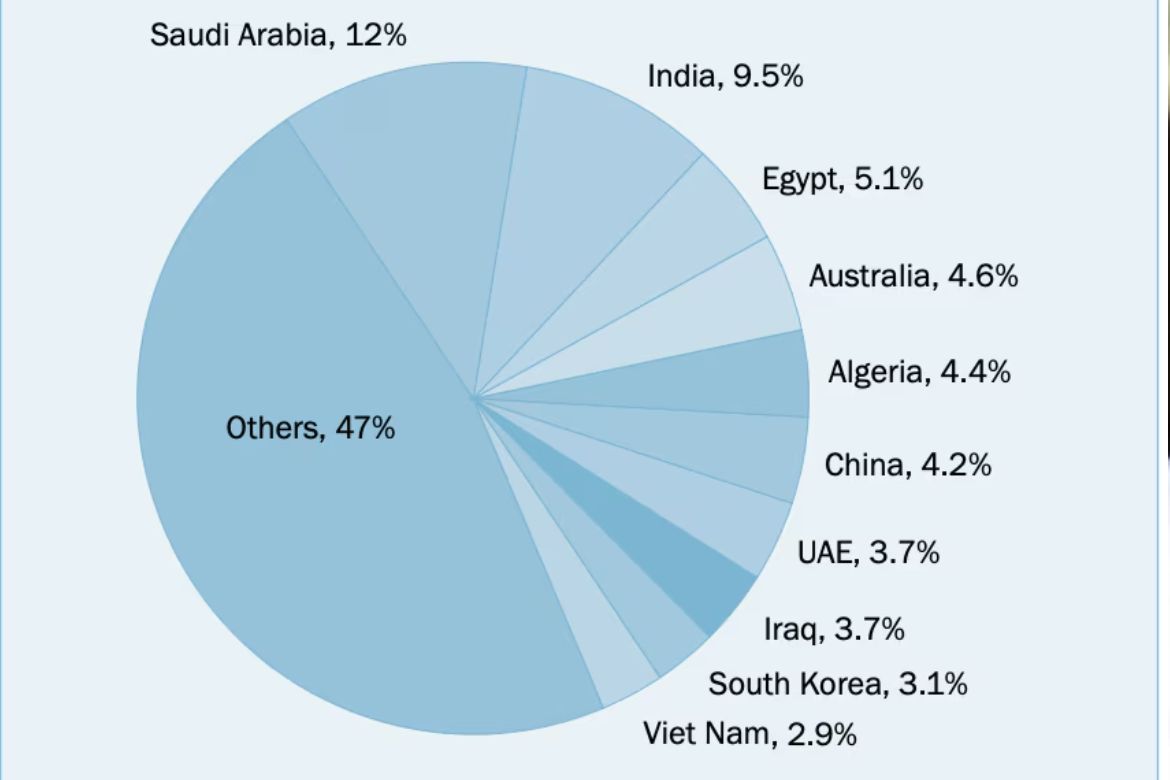
Among the leading buyers of American weapons was Saudi Arabia, which received around 12 per cent of US arms exports during the period. The kingdom — the largest oil producer within the Organization of the Petroleum Exporting Countries — continues to invest heavily in military modernisation as regional security challenges evolve.
Major global arms suppliers
While the US leads the market by a large margin, France ranked second among global arms exporters with a 9.8 per cent share of total transfers.
Other major suppliers include:
Russia
Germany
China
Together, these five countries accounted for roughly 70 per cent of global arms exports, reflecting their dominant role in the international defence industry.
Meanwhile, Israel ranked seventh with a 4.4 per cent share of global exports, while Iran placed 25th with 0.3 per cent, exporting mostly domestically produced weapon systems to partners such as Russia, Venezuela, and the Houthi movement.
Arms exports reinforce strategic alliances
Experts say US arms sales play a key role in strengthening geopolitical partnerships.
“For importers, US arms provide advanced capabilities and help build strong relations with Washington,” said Pieter Wezeman, a senior researcher at SIPRI.
The strategy aligns with the America First Arms Transfer Strategy, introduced during the administration of Donald Trump, which promotes American-made defence equipment globally while supporting domestic manufacturing and maintaining technological superiority.
According to Wezeman, the United States has further strengthened its leadership in the global arms trade, even as global power dynamics shift toward a more multipolar system.
Ukraine becomes the largest arms importer
The report also highlights major shifts in global demand. Ukraine emerged as the largest importer of major weapons between 2021 and 2025, accounting for 9.7 per cent of global arms imports.
This marks a dramatic rise from just 0.1 per cent in the previous five-year period, largely due to the ongoing conflict with Russia.
Other leading arms importers include:
India
Saudi Arabia
Qatar
Pakistan
In the Gulf region, Kuwait ranked ninth globally, while the United Arab Emirates came in at 11th with 2.7 per cent of global imports.
Gulf defence spending remains significant
The strong presence of Gulf countries among the world’s leading arms importers reflects ongoing efforts to strengthen defence capabilities amid regional tensions.
The United States remains the largest supplier to Gulf Cooperation Council countries, providing:
77% of Saudi Arabia’s arms imports
48% of Qatar’s imports
62% of Kuwait’s imports
42% of the UAE’s imports
France also continues to be a major defence partner for Gulf states.
However, SIPRI data shows that overall arms imports in the Middle East declined by 13 per cent between 2021 and 2025, compared with the previous five-year period. Arms imports by the UAE also fell by 15 per cent during the same timeframe.
According to Zain Hussain, a researcher at SIPRI, Gulf states are balancing long-standing defence partnerships with efforts to diversify suppliers.
“With regional tensions and ongoing conflicts, Gulf Arab states are strengthening ties with established partners such as the US and France while also exploring new defence suppliers,” he said.
Defence industry revenues surge
The report comes amid continued growth in the global defence sector. SIPRI previously reported that the 100 largest arms-producing companies generated a record $69 billion in revenue in 2024, marking a 5.9 per cent increase year-on-year.
Nine of those companies were based in the Middle East, collectively generating $31 billion in revenue from arms and military services.
Experts say Gulf nations will continue to influence arms import trends across the region as geopolitical tensions and security concerns evolve.
