

The world’s next great energy revolution may not be happening on Earth.
More than half a century after aerospace engineer Peter Glaser first proposed collecting solar energy in space and transmitting it back to Earth, governments and scientists are turning the once-radical concept into a serious technological ambition. Nations including the United States, China, the United Kingdom, Japan, India and Russia are now investing in research aimed at harvesting the sun’s energy from orbit and delivering it directly to power grids below.
Unlike traditional solar farms, which depend on daylight and clear weather, space-based solar power systems could generate electricity almost continuously. Positioned above Earth’s atmosphere, orbital solar arrays would receive uninterrupted sunlight for most of the year, bypassing clouds, storms and the day-night cycle that limits terrestrial renewable energy.
A Potential Breakthrough for Net-Zero Goals
Researchers believe the technology could play a transformative role in helping countries achieve climate targets while reducing dependence on fossil fuels. Studies have suggested that orbital solar stations could dramatically strengthen renewable energy systems by supplying stable electricity even when wind turbines and ground-based solar panels are not producing power.
According to recent academic research, widespread deployment of space solar technology could significantly reduce the need for additional land-based renewable infrastructure while lowering overall electricity system costs. The findings have sparked growing interest among policymakers and energy planners looking for long-term solutions to rising power demands.
Professor Wei He of King’s College London says the concept is moving beyond theory and towards real-world testing.
“In space, you potentially have the ability to position solar panels to always face the sun, which means power generation can be nearly continuous compared to the daily pattern on Earth.”
His team argues that emerging technologies could make space solar power an important contributor to the global transition toward net-zero emissions.
How Electricity Would Be Sent from Space
The concept resembles today’s communications satellites, but instead of transmitting data, these spacecraft would transmit energy.
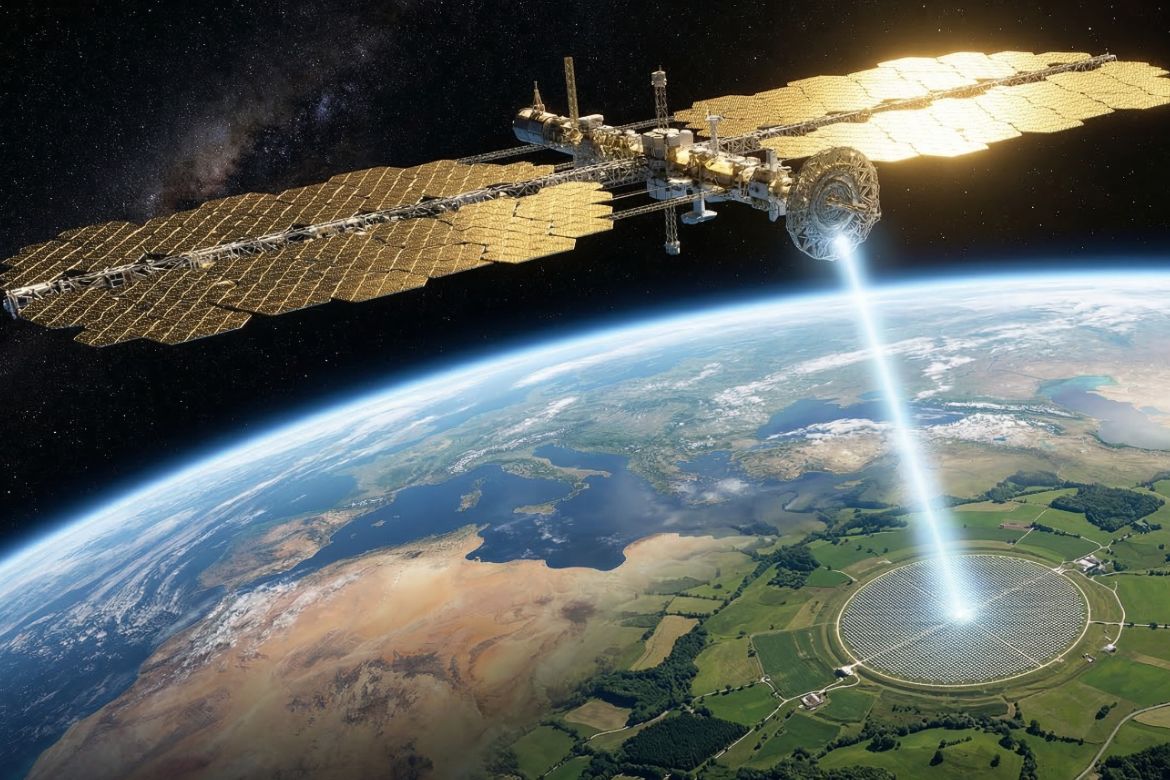
Massive solar arrays would collect sunlight in orbit before converting it into microwaves or laser beams. Those beams would then be directed toward specially designed receiving stations on Earth, where the energy would be converted into electricity and fed directly into national power grids.
The approach offers another significant advantage: energy infrastructure in space would be protected from floods, earthquakes, storms and other natural disasters that can disrupt terrestrial power networks.
Technology Is Finally Catching Up
For decades, the idea remained out of reach because of enormous launch costs and technological limitations. Today, however, advances in solar-cell efficiency, wireless power transmission and reusable rocket technology are changing the equation.
Recent demonstrations have shown that wireless power can be transmitted successfully over long distances, including experimental orbit-to-Earth energy transfers. Researchers also point to major improvements in radiation-resistant solar panels and lower-cost satellite manufacturing as evidence that the technology is becoming increasingly viable.
China has already begun testing key elements of future orbital power systems through its “Sun Chasing” programme, while American researchers continue to advance microwave and laser-based transmission technologies.
Two Designs, One Goal
Scientists are currently evaluating different approaches to orbital energy generation.
One concept, known as the Innovative Heliostat Swarm, uses large networks of reflective satellites designed to maximize continuous sunlight collection. Another, called the Mature Planar Array, relies on a simpler architecture and is considered closer to commercial readiness.
Researchers believe combining the strengths of both designs could accelerate development and help overcome technical challenges that still stand in the way of large-scale deployment.
The Vision of Peter Glaser Lives On
The renewed excitement surrounding space-based solar power traces back to Dr Peter Glaser, the Czech-born engineer who first published the concept in 1968.
Glaser envisioned giant orbital stations collecting sunlight and transmitting power back to Earth. He later secured a patent for the idea, but the technology of the era could not support such an ambitious undertaking. While his proposal remained largely theoretical for decades, many experts now view it as one of the most promising long-term energy concepts under development.
Today, with governments racing to secure future energy supplies and meet climate commitments, Glaser’s vision is receiving a second look.
A Race Beyond Earth
Significant engineering, financial and regulatory hurdles remain before electricity from space becomes commercially available. Yet momentum is building rapidly as research institutions, aerospace companies and governments compete to unlock a new frontier of renewable energy.
What began as a bold thought experiment in the 1960s is increasingly being viewed as a realistic pathway toward clean, uninterrupted power generation. If successful, the next energy revolution may come not from beneath the ground or across the oceans, but from high above our planet.
