

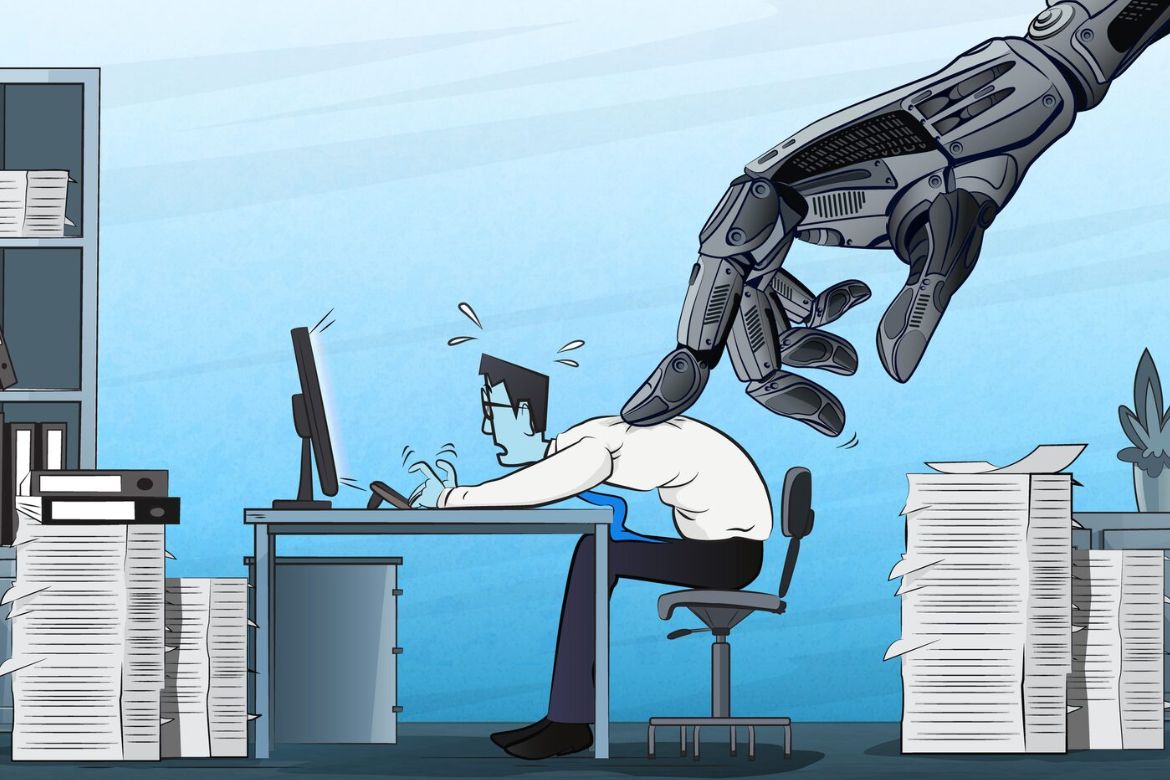
Artificial Intelligence is transforming workplaces across the Gulf and beyond. From drafting reports and generating code to analyzing data and responding to customer queries, AI is helping employees complete tasks in minutes that once took hours.
Yet despite rapid adoption and significant investments, many organizations are struggling to translate these efficiency gains into measurable business outcomes.
The question facing executives today is not whether AI can make work faster. It clearly can.
The more important question is whether faster work automatically leads to higher productivity, stronger growth, and greater competitiveness.
Evidence increasingly suggests it does not.
The AI Productivity Paradox
AI excels at improving individual tasks. It can reduce the time spent writing, researching, coding, planning, and communicating. Employees become more efficient, and organizations often see immediate gains in output.
However, companies do not create value through isolated tasks. They create value through interconnected systems of people, processes, decisions, and customer experiences.
Making one part of the system faster does not necessarily improve the performance of the entire system.
A report generated in ten minutes instead of two hours still requires review, approval, decision-making, and execution. If those organizational bottlenecks remain unchanged, the overall productivity gain may be far smaller than expected.
This explains why many businesses are discovering that efficiency improvements do not automatically translate into financial returns.
Efficiency Is Not the Same as Value
Many AI investments begin with a straightforward objective: reducing the time required for work.
While cost savings matter, they represent only part of the opportunity.
As AI tools become widely available, efficiency quickly becomes a baseline expectation rather than a competitive advantage.
The organizations that create the greatest value from AI are asking a different question:
What can we now do that was previously impossible, too expensive, or too slow?
This shift moves the conversation from cost reduction to value creation.
For fast-growing economies such as the UAE and the wider GCC, AI’s greatest contribution may not be replacing human effort but amplifying expertise, expanding services, accelerating innovation, and enabling organizations to serve more customers effectively.
The Missing Piece: Organizational Redesign
Many companies are redesigning tasks around AI but not redesigning the organization itself.
This creates a mismatch.
A workflow may include AI research tools, AI analysis engines, and AI-generated recommendations. Individually, each step becomes faster.
But organizational performance depends on how these pieces connect.
Human workers often perform invisible but critical functions. They challenge assumptions, identify unusual situations, connect information across departments, and take responsibility when outcomes matter.
These contributions rarely appear in productivity dashboards, yet they are essential to business success.
Simply automating tasks without redesigning workflows can create new risks and inefficiencies.
Accountability Still Matters
One of the most important questions in the AI era is not:
“Can AI perform this task?”
Instead, leaders should ask:
“Who verifies the output, and who remains accountable for the result?”
AI can generate answers, but organizations still need mechanisms to validate accuracy, assess risk, and ensure quality.
Successful businesses will focus not only on automation but also on verification.
Human judgment remains indispensable where consequences are significant, decisions are complex, or accountability cannot be delegated.
The Future Role of Human Workers
Contrary to popular fears, the future workplace is unlikely to be human versus machine.
Instead, it will be human plus machine.
The most valuable employees may not be those who complete routine tasks fastest, but those who excel at defining problems, exercising judgment, validating solutions, and making strategic decisions.
As AI handles more execution work, uniquely human capabilities become even more important.
Creativity. Critical thinking. Leadership. Empathy. Accountability.
These skills cannot be easily automated.
The Gulf Opportunity
Across the GCC, governments and businesses are investing heavily in AI as part of national economic transformation strategies.
The opportunity is enormous.
However, the winners will not necessarily be the organizations that adopt AI first.
They will be the organizations that redesign themselves most effectively around AI.
Technology alone cannot create competitive advantage.
People, processes, culture, and leadership remain the foundations of long-term success.
AI is proving remarkably effective at making employees faster.
But speed alone does not guarantee productivity.
Organizations that focus solely on automation may discover they have become more efficient without becoming significantly more valuable.
The true promise of AI lies not in doing existing work faster, but in reimagining how work gets done altogether.
The companies that thrive in the coming decade will not be those with the most AI tools.
They will be those that combine AI capabilities with intelligent organizational design, strong human judgment, and a clear vision for value creation.
