

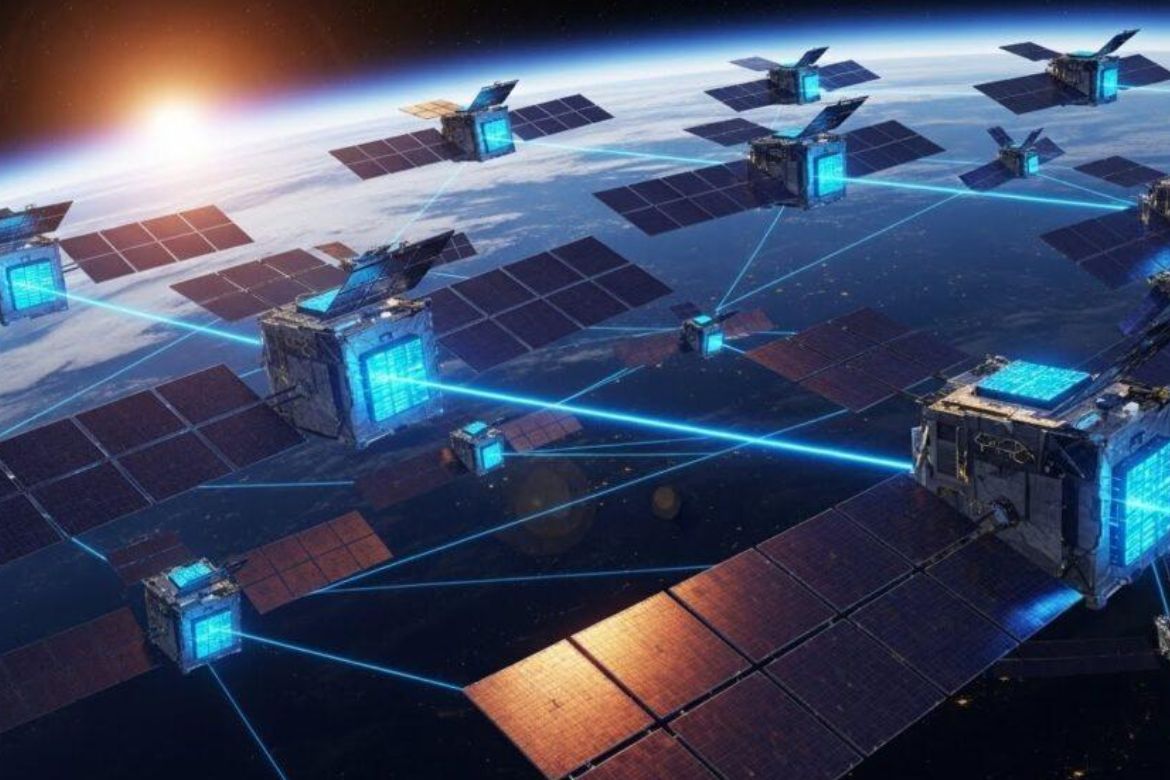
The United States has granted regulatory approval to Elon Musk’s SpaceX to develop an ambitious project aimed at placing data centres in space, as the rapid growth of artificial intelligence (AI) increases global demand for computing power.
According to the Federal Communications Commission (FCC), the approval represents the first authorisation for a project of this kind. The decision allows SpaceX to deploy up to one million orbital computing modules designed to process massive amounts of data in space and transmit the results back to Earth.
“The FCC is granting SpaceX authorisation to deploy 1,000,000 orbital compute modules to process massive amounts of data to be used back here on Earth,” the commission announced on November 25.
The development comes amid growing concerns about the electricity consumption, environmental impact, land requirements and infrastructure costs associated with conventional data centres.
Why Does SpaceX Want to Build Data Centres in Space?
The growing popularity of generative AI, cloud computing and other advanced digital technologies has significantly increased the demand for data processing infrastructure.
Traditional data centres require substantial amounts of electricity, sophisticated cooling systems and large areas of land. Their expansion has also generated concerns among communities and governments over environmental impact, noise pollution and pressure on local electricity networks.
Some state and local governments in the United States have introduced measures to slow or restrict new data centre construction amid these concerns.
Moving computing infrastructure into space could offer an alternative approach.
Space-based data centres could potentially use solar energy more extensively and reduce dependence on terrestrial electricity networks. They could also avoid some of the land and water requirements associated with conventional facilities.
However, the technology remains experimental, and its commercial viability has yet to be established.
FCC Chairman Highlights America’s Technological Ambitions
FCC Chairman Brendan Carr welcomed the development, describing it as an opportunity to combine America’s strengths in space exploration and advanced technology.
“This is the kind of American ingenuity that can unite our strengths in space and advanced technology, reinforce our economic leadership, and expand prosperity here at home,” Carr said.
The authorisation is an important regulatory milestone for SpaceX, but it does not mean that a fully operational network of orbital data centres will be available immediately.
Researchers and technology companies are still investigating how such systems could operate reliably and economically in the challenging environment of space.
Google Is Also Exploring Space-Based AI Computing
SpaceX is not the only technology company exploring the possibility of moving AI computing infrastructure beyond Earth.
Google has been developing Project Suncatcher, an initiative designed to investigate whether AI computing systems can operate effectively in space.
In October 2026, the company advanced its research through an orbital technology demonstration. Google included its AI hardware aboard the Transporter-18 SpaceX mission to test the feasibility of operating computing systems in orbit.
One of the key objectives is to determine whether the technology can generate sufficient computing power in space to answer basic AI queries.
Google has highlighted the potential advantages of solar energy in low-Earth orbit.
“In low-Earth orbit, satellites can access near-constant sunlight, generating up to eight times more solar power than on Earth,” the company said.
The technology company also suggested that multiple satellite constellations could eventually be connected to handle increasingly demanding AI workloads.
If successful, such developments could offer a new approach to powering the next generation of artificial intelligence infrastructure.
Elon Musk Previously Discussed Moving AI Infrastructure into Space
Space-based data centres have also featured in Elon Musk’s broader vision for the future of artificial intelligence and space technology.
Speaking at the World Economic Forum’s annual meeting in Davos, Switzerland, in January 2026, the SpaceX chief executive discussed the enormous potential of using solar energy in space to support large-scale computing infrastructure.
“There’s so much room in space, and it’s enormous what you can scale to,” Musk said.
“I think, ultimately, you can have hundreds of terawatts in the air.”
His comments reflect a growing interest among technology leaders in exploring space as a potential location for future computing infrastructure, particularly as AI systems require increasingly powerful processing capabilities.
Scientists Warn of Major Engineering Challenges
Despite the ambitious plans, experts caution that establishing data centres in space is considerably more complicated than it might initially appear.
Ariel Ekblaw, founder and chief executive of the Aurelia Institute, a non-profit space architecture research organisation, has questioned some of the aggressive timelines proposed for making orbital data centres commercially viable.
Speaking at the Semafor World Economy Summit in April, she highlighted the difficulty of managing the heat generated by powerful computing equipment in space.
Although space is often associated with extremely cold temperatures, removing heat from electronic equipment in a vacuum presents a significant engineering challenge.
Ekblaw described the problem by noting that space is not necessarily an advantageous environment for deploying large amounts of heat-generating computing hardware.
Radiation exposure is another major concern. High-energy particles in space can damage electronic components and affect the reliability of processors.
Maintenance and hardware upgrades also present practical difficulties.
On Earth, technology companies can regularly replace processors, graphics processing units (GPUs) and other components as newer generations become available.
In space, replacing equipment could require specialised missions, making routine upgrades considerably more complicated and expensive.
Ekblaw also pointed out that companies accustomed to upgrading Nvidia chips every six months would face significant logistical challenges if those systems were located in orbit.
These concerns highlight why the transition from experimental demonstrations to large-scale commercial operations could take considerably longer than some projections suggest.
Could Space Data Centres Change the Future of AI?
The approval of SpaceX’s proposal reflects a broader shift in how technology companies are approaching the growing demand for artificial intelligence.
If the technology becomes commercially practical, orbital data centres could introduce new opportunities for satellite communications, renewable energy, semiconductor manufacturing, space engineering and advanced computing.
They could also provide an additional source of computing capacity as conventional data centres face increasing pressure from energy consumption, infrastructure costs and environmental regulations.
However, significant questions remain about launch costs, equipment reliability, cooling systems, radiation protection, maintenance and orbital congestion.
The technology must demonstrate that it can compete economically with data centres on Earth before widespread adoption becomes realistic.
A New Frontier for the Global Technology Industry
The US approval of SpaceX’s proposed orbital computing network marks an important development in the intersection of artificial intelligence and space exploration.
With Google also investigating the possibilities through Project Suncatcher, the idea of operating AI infrastructure beyond Earth is gaining attention among some of the world’s largest technology companies.
For now, the concept remains at an early stage, with considerable technical and economic challenges still to be addressed.
Nevertheless, as demand for computing power continues to grow, space could eventually become part of the infrastructure supporting the next generation of artificial intelligence.
