

The Democratic Party’s victory in the US midterm elections has raised fresh questions about the growing influence of Big Tech and artificial intelligence in American politics.
While some political commentators have attributed part of the Republican Party’s setback to public resistance against technology companies, the underlying frustration appears to extend far beyond partisan politics.
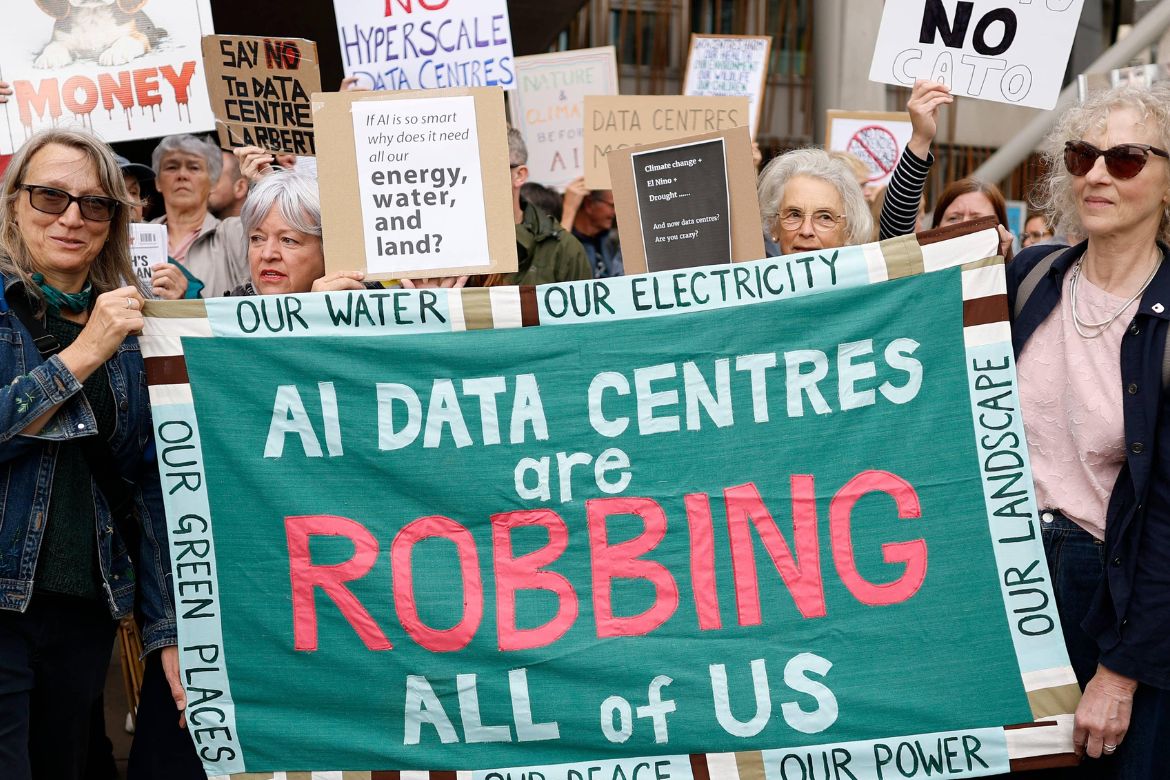
At the centre of the debate are data centres, the massive facilities powering the artificial intelligence boom. Their rapid expansion has triggered concerns over electricity consumption, water use, environmental consequences and the impact on communities where these developments are planned.
However, the growing anger directed at technology companies is unlikely to disappear following the midterms.
Instead, it could become an increasingly significant political issue as Americans turn their attention towards the 2028 US presidential election.
The election results may have exposed only the beginning of a much broader confrontation between the public and the technology industry.
Data Centres Become a Political Flashpoint
For several years, technology companies have promoted artificial intelligence as a transformative force capable of strengthening the economy, improving productivity and creating new opportunities.
Yet the infrastructure required to support this technological expansion has increasingly become a source of public frustration.
Communities across the United States have raised concerns about data centres being constructed near residential areas, often with limited information available about their potential consequences.
Residents have questioned the impact of these developments on local electricity supplies, water resources, noise levels and the environment.
In some cases, developers have reportedly relied on non-disclosure agreements that have limited the information available to communities before projects move forward.
These concerns have increasingly prompted residents to challenge proposed developments through city councils, town halls, municipal meetings and legal action.
The controversy surrounding data centres has therefore become more than an infrastructure debate. It has evolved into a question of whether communities have sufficient control over developments that could fundamentally affect their lives.
For many residents, the issue is straightforward: they want to know what is being built, who will benefit and what the consequences will be for their communities.
Why the Big Tech Backlash Goes Beyond Party Politics
Some commentators have described the Republican Party’s midterm losses as a consequence of public resistance to Big Tech and artificial intelligence.
There is merit to that argument, particularly given the growing opposition to data centre developments.
However, it would be a mistake to assume that the anger is exclusively directed at Republicans or that it will disappear once the election cycle moves forward.
Concerns about AI and technology companies are increasingly connected to broader issues of economic security, environmental protection and corporate accountability.
Americans are questioning whether the benefits of the AI boom are being distributed fairly, especially when communities face the potential consequences of infrastructure expansion without necessarily receiving meaningful economic benefits.
The debate is also becoming increasingly personal.
As AI tools become more prominent in workplaces, employees are confronting questions about the future of employment, the cost of technology and the growing influence of a small number of powerful companies.
These concerns are unlikely to disappear simply because an election has concluded.
Donald Trump’s Influence on Big Tech Remains Significant
The relationship between US President Donald Trump and major technology executives has also become an important part of the debate.
Although Trump will not be eligible to run for another presidential term in 2028, his influence over the technology industry is likely to remain significant.
Critics have argued that some technology executives have increasingly adopted elements of Trump’s political communication style, including aggressive messaging, dismissing criticism and presenting opposition as politically motivated.
The comparison is particularly relevant when examining how technology companies respond to public concerns about AI infrastructure.
For years, residents have raised questions about data centres suddenly appearing near their communities. Yet some industry leaders and proponents of unregulated AI have continued to dismiss these concerns.
Trump has also repeatedly rejected criticism of AI and data centre development, at times suggesting that opposition could be linked to foreign interference.
While foreign governments can use social media to influence public opinion, such activity does not explain the local concerns being raised across the United States.
Electricity costs, water consumption, environmental pressures and a lack of transparency are genuine issues that require meaningful responses.
Dismissing them as a conspiracy risks deepening public distrust.
Kevin O’Leary’s Utah Data Centre Controversy
One of the most prominent examples involves entrepreneur Kevin O’Leary and his proposed 40,000-acre data centre development in Utah.
The project attracted significant opposition from residents of Box Elder County, where concerns about the scale and potential consequences of the development became increasingly contentious.
O’Leary suggested that opposition to the project was connected to efforts by the Chinese government to create divisions within the United States.
However, the allegations were disputed, and Fox News subsequently corrected its reporting after airing the claims.
The network clarified that O’Leary had acknowledged having no evidence that the advocacy group Alliance for a Better Utah, or activists Josh Kanter and Taylor Knuth, were funded by China or the Chinese Communist Party.
The controversy also resulted in defamation lawsuits involving claims made about opponents of the project.
The episode illustrates the risks associated with dismissing community opposition as foreign interference without substantiating the allegations.
For residents, the central questions concerned the proposed development and its potential impact on their community.
The controversy demonstrated how quickly a local infrastructure dispute can evolve into a broader debate about political rhetoric, corporate accountability and public trust.
Rather than addressing the concerns directly, the foreign-interference allegations intensified the controversy surrounding the project.
Sam Altman’s Comments Add to Consumer Concerns
The backlash against Big Tech has also been fuelled by the increasingly visible public statements of technology executives.
Many leaders in the industry have taken to social media and podcast interviews to promote the benefits of artificial intelligence.
However, some of these comments have attracted criticism, particularly when they appear disconnected from the concerns of ordinary consumers.
OpenAI chief executive Sam Altman recently faced criticism following comments about the growing shortage of computer memory, or DRAM, which has contributed to rising prices for consumer electronics.
Speaking on the Cheeky Pint podcast, Altman argued that from a global resource-allocation perspective, it was inefficient for individuals to have large amounts of the world’s limited DRAM supply sitting in their personal computers, potentially being used only a small percentage of the time.
The comments were interpreted by critics as suggesting that consumers’ access to computing resources should take a back seat to the needs of the AI industry.
Altman’s remarks also attracted criticism from Elon Musk, his long-time rival in the technology sector.
The debate highlights a growing tension between the interests of technology companies developing AI infrastructure and the expectations of consumers who rely on affordable computers, smartphones and other devices.
For many people, the concern is not simply whether artificial intelligence can deliver technological progress.
It is whether that progress will come at the expense of their access to essential technology and their financial security.
The Debate Over Artificial Intelligence Is Also a Debate Over Branding
The political controversy surrounding AI has increasingly extended into the language used to describe the technology.
Trump has previously suggested that artificial intelligence suffers from a branding problem and advocated the use of the term “super intelligence” instead.
The proposal reflects a broader effort by some technology proponents to frame AI as a revolutionary force capable of delivering unprecedented benefits.
However, changing the terminology does little to address the underlying concerns.
Whether it is described as artificial intelligence, super intelligence or another technological concept, the public’s questions remain largely unchanged.
Who benefits from the technology?
Who bears the costs?
And who is accountable when the consequences affect communities, workers and consumers?
These questions are becoming increasingly important as AI infrastructure expands across the United States.
Democrats Could Increase Pressure on Big Tech
The Democratic Party’s victories in the midterm elections are expected to bring renewed scrutiny of the technology industry.
Democrats have historically been more supportive of stronger regulation in areas such as corporate accountability, privacy and consumer protection.
With control of Congress, the party could seek to increase oversight of major technology companies and examine the consequences of rapid AI expansion.
However, the extent of any regulatory changes remains uncertain.
The technology industry continues to wield considerable economic and political influence, and disagreements over the appropriate level of AI regulation are likely to persist.
The election results also do not guarantee that every concern raised by communities opposed to data centres will translate into federal legislation.
Nevertheless, the political environment has changed.
Technology companies may find it increasingly difficult to dismiss public opposition as a temporary inconvenience or a partisan campaign.
Why the Backlash Could Continue Until 2028
The next US presidential election is scheduled for 2028, and the debate over artificial intelligence is likely to remain prominent.
Several issues could continue to shape public opinion:
- Energy costs: Whether the expansion of data centres places additional financial pressure on households.
- Employment: Whether AI creates new opportunities or accelerates job displacement.
- Environmental concerns: How companies manage water consumption, energy requirements and local environmental consequences.
- Community rights: Whether residents receive sufficient information and meaningful opportunities to influence development decisions.
- Corporate accountability: Whether technology executives face stronger oversight from lawmakers and regulators.
- Privacy: Whether AI-powered technologies increase the risks associated with personal data collection.
These issues are interconnected.
A community concerned about a proposed data centre may also be worried about electricity bills, employment opportunities and the influence of major corporations over local decision-making.
As these concerns become more visible, the political consequences could extend well beyond individual infrastructure projects.
For technology companies, the challenge will be to demonstrate that innovation can deliver tangible benefits without placing an unfair burden on communities and consumers.
The Future of Big Tech Depends on Public Trust
The technology industry’s influence on the global economy is unlikely to diminish. Artificial intelligence, cloud computing and digital infrastructure will continue to play important roles in business, government and everyday life.
However, the political environment surrounding these technologies is changing.
The US midterm elections have demonstrated that public concerns about AI and data centres can become significant political issues.
The growing backlash is not simply a reaction to technological change. It reflects deeper questions about economic fairness, transparency, corporate influence and the relationship between powerful companies and ordinary citizens.
For an industry accustomed to presenting innovation as an unquestionable public good, this represents a significant shift.
The central question is no longer simply how quickly artificial intelligence can advance.
It is whether the companies driving that advancement can earn the public’s trust.
As the United States moves towards the 2028 presidential election, that question could become one of the most consequential debates in American politics.
The anger directed at Big Tech may have only just begun.
